The "Backslash Backlash:" Counties pivot in the data center buildout


Key Takeaways
For years, county officials have wondered what would get residents interested in local issues or encourage them to participate in public meetings. More than a few have probably asked a search engine or prompted artificial intelligence for ideas — and they were onto something.
Data centers, which power internet searches like those, have done just that. The physical infrastructure housed in enormous warehouses must go somewhere, and in the United States, “somewhere” means a county.
Two years ago, a data center might have seemed like a gift to a county looking for an economic boost. But a May 2026 Gallup poll found that seven in 10 Americans don’t want one built near them.
Data centers have become a linchpin of national and regional economic growth, a challenge for local elected leaders seeking to maintain control over land use and a puzzle for energy infrastructure and long-term planning. Most notably, they’ve pitted county officials against frustrated, sometimes angry, crowds. As the potential tax revenue for counties from these projects grows, so does public suspicion of the decision-makers, fueled by misgivings about the pace of technological advances.
“We couldn’t answer the misinformation fast enough,” said Box Elder County, Utah, Commissioner Lee Perry of a proposed data center in his county. “People got mad at us because they were worried about air quality and water, but those are under federal and state jurisdiction. I got emails from people in Florida saying we had to vote against this because the fate of the world depended on us.”
Learn more
NACo Data Centers Resource Hub
Loudoun County, Va. Supervisor Michael Turner's Data Centers and Power Resources
Key Considerations for Data Center Development
Cuyahoga County, Ohio's Recommendations for Local Communities
Cleanview tracks 1,341 operating data centers in the United States, with an additional 2,539 projects in progress. One proposed data center is Stratos, a 40,000-acre project that Perry and his colleagues learned about in March 2026. They said the state’s Military Installation Development Authority had backed them into a corner, leaving them among the last to know.
The commissioners moved a May 2026 meeting to a building at the county fairgrounds that could hold more than 1,100 people. The land in question for Stratos, north of the Great Salt Lake, was miles from the nearest home. The project would draw water from agricultural sources and, most crucially for the county, sit on unzoned land, limiting the commissioners’ oversight. By the time the meeting began, the story had gone national. Speakers could barely get half a sentence out before the crowd drowned them out.
“We will not allow shouting, we will not allow cat calling. We expect you to be kind,” Commissioner Tyler Vincent pleaded with the audience early in the meeting.
Eventually, the commissioners retreated to a separate room to vote, broadcasting the proceedings to the auditorium. The county had solicited public feedback online before the meeting and counted 2,500 comments, 262 of them from Box Elder County residents.
Perry argued that the commission’s vote in favor of the project ensured the county would have some role in determining its future, making it easier to retain some control over the projected $30 million in annual property tax revenue. That figure was expected to grow to $108 million annually — double Box Elder County’s current budget. Several partners in the deal reportedly told the commissioners that the project would move forward one way or another.
“It’s like you’re a bank teller and a bandit sticks a gun in your face and tells you to empty the drawer,” Perry said. “An onlooker will say the guy was never going to shoot you, or he didn’t have bullets in the gun, but you don’t know that when the gun’s in your face.”
Simple design, complex applications
For all their mystery, data centers are relatively simple. Inside the windowless buildings are warehouses full of computers surrounded by cooling infrastructure. While nearby roads can swell with construction crews and vehicles for 12 to 18 months, staffing and traffic are limited once the facilities are up and running. Data centers don’t place significant demands on schools and, with proper planning, can be confined to designated parts of a county where local land use authority applies.
Data centers generate tax revenue for counties in several ways, but real property taxes (on real estate) and personal property taxes (on equipment) can provide significant revenue infusions. Community benefits agreements can sweeten the deal.
But their apparent simplicity belies the challenges developers face as they seek new sites with the power and IT infrastructure needed to support operations.
“Think of a normal industrial-type project where there’s power needs, there’s water needs, there’s construction impact and then multiply those by 100,” said Linn County, Iowa, Planning Director Charlie Nichols, whose county has one data center and two more on the way. “If you have not experienced one of these projects before, it’s hard to be completely ready.”
That includes preparing for concerns about noise, the effects on power and water bills, and how close those enormous, plain-looking buildings will be to homes.
Counties also face pressure to keep their economies moving. An analysis by the Federal Reserve Bank of St. Louis found that recent investments in AI-related categories contributed significantly to real GDP growth in 2025. AI companies are expanding in hopes of delivering on the $10.3 trillion in domestic investment that economist Stijn Van Nieuwerburgh projected would go toward infrastructure buildout between 2025 and 2032, averaging 3.63% of GDP annually.
And while counties compete with one another to attract data centers, the Trump administration is encouraging development on public land — a notoriously challenging proposition for counties seeking to generate tax revenue — which would leave the data centers in the counties without the benefits.
It’s a lot to place on the shoulders of often-part-time county leaders whose agendas have been full for years.
“They’re getting bombarded by data center developers who are throwing unbelievable sums of money at them,” said Michael Turner, a supervisor in Loudoun County, Va., the data center capital.
His county’s 233 data centers generate more than $1.3 billion in property taxes annually, accounting for more than 40% of the county’s budget. That revenue has helped enable residential property tax cuts and fund the county’s school system.
Turner, who is in his second year as chair of NACo’s Energy, Environment and Land Use Policy Steering Committee, has drawn on Loudoun County’s 26 years of experience with data centers to become a leading local government expert in the field. He shares his insights in materials on his district website and tours the country speaking to state associations of county officials. He stresses the need to plan around six key concerns: noise, power, water, emissions, setbacks and appearance.
“There’s a tremendous disparity of what they know, but wherever their county is in the process, they generally have similar questions,” he said of county officials. “I try to think that if I were in this person’s shoes, and this is what I was facing, what would be a solution?”
What concerns Turner most is the potential for further state preemption of county zoning authority, as has happened in neighboring West Virginia.
“If you ask tough questions and you really work hard to negotiate the proper arrangement for a county, there’s always a possibility that the industry will go to the state and get them to take the authority away from the county, so they don’t have to have these conversations,” he said.
He recently saw that scenario play out in a Kentucky county.
Not all projects span 40,000 acres or are touted as among the largest in the country. Calloway County, Mo., is in the process of finalizing a 200-acre development with two buildings totaling 700,000 square feet.
“This isn’t a huge project,” said Presiding Commissioner Gary Jungermann. “It’s just cloud storage, and it’s all a bit smaller than the average.”
The letter, spirit and zeitgeist of the law
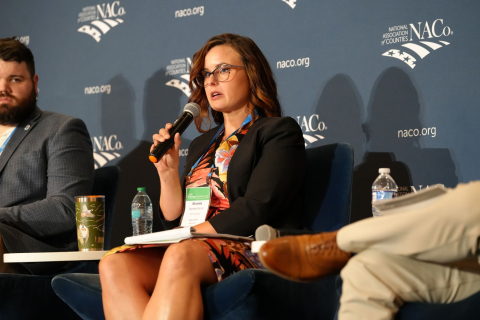
Hundreds of counties have enacted moratoriums targeting some aspect of data center development, mostly since the summer of 2026, in hopes of slowing development while they prepare their county codes. Meanwhile, Texas Gov. Greg Abbott (R) and New York Gov. Kathy Hochul (D) have both issued statewide moratoriums, and Maryland Gov. Wes Moore (D) is requiring projects above a certain capacity to undergo review.
County planning staff members are divided over the wisdom of imposing moratoriums on data centers.
Nichols believes moratoriums can signal urgency to partners and help bring a region together to develop an integrated plan. That’s how Linn County is approaching its moratorium, which is set to expire at the end of 2027.
“We’re inviting representatives from every city and a few neighboring counties to participate in a committee that’s looking at data centers, but also connected development, power production, energy storage, all that kind of stuff to come up with a shared set of principles and vision for how this development works, so that we can move forward as a region instead of each of us having our own separate requirements,” he said during NACo’s Energy Symposium in Potter County, Texas, in September.
His counterpart in Grant County, Wash., believes moratoriums often reflect a lack of planning.
“A lot of local officials are just choosing to go with moratoriums, and I feel like that’s just kicking the can down the road,” Michelle Mercer said in response to Nichols. “I think they are, from a staffing perspective, very rushed and reactive.”
Counties should start reviewing their zoning codes and ordinances now, she said.
“Even if you don’t think [data centers] are coming to your area soon, I would get ahead of it as much as you can. And I feel like the worst codes are those that are rushed, even if it is an 18-month or 24-month timeline.”
McKenzie County, N.D. passed a three-page data center ordinance in 2024 that seems quaint by today’s standards. The current draft revision is nearly three times as long and reflects months of work by the county, its cities and residents.
Commissioner Joel Brown said McKenzie County was motivated to get its ordinance right after dealing with a troublesome nearby cryptocurrency mining operation.
“We knew we needed to get ahead of this before there were any applications or any developers that were truly knocking on the door in McKenzie County,” he said.
He visited a data center elsewhere in North Dakota and joined a 15-person trip to Laramie County, Wyo., to examine how Microsoft and Meta data centers had changed the community around Cheyenne over 14 years. The group included county, city, economic development, planning and zoning personnel, along with residents who had voiced concerns about data centers.
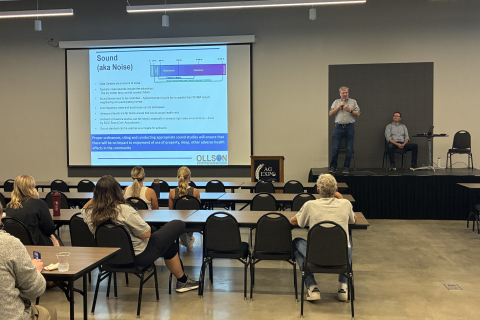
The county then held community open houses featuring experienced subject-matter experts who could address concerns about different aspects of data centers, particularly noise.
“We didn’t get started late on this,” Brown said. “We’ve had a lot of experience already in educating ourselves on data center development.”
He feels good about the revised draft ordinance as he discusses concerns with residents.
“Anytime I’ve got an opportunity to talk to a citizen who maybe leans towards an anti-data center mindset or proposal of a moratorium, when I start asking them about their specific concerns, there’s not one that we don’t have a really robust understanding of or that isn’t addressed already in the ordinance that we’re proposing,” he said.
He admits, though, that McKenzie County, located in the Bakken oil fields, likely has a different perspective on development than other rural counties.
“We live in a heavily industrialized area already,” he said. “It’s something we’re accustomed to and we’re probably a lot more comfortable with it than most rural counties are.”
One of one
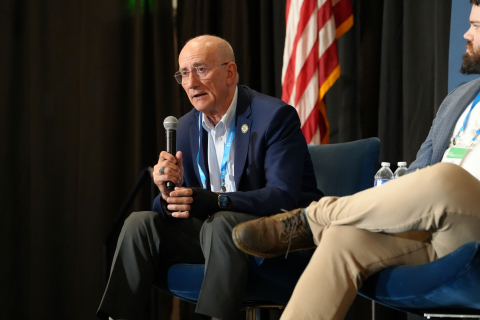
Data centers moved into Loudoun County like a hermit crab claiming an empty shell. Data storage companies took advantage of infrastructure left over from the dot-com boom of 2000, and by 2003, data centers had been included in the county’s zoning ordinance. Five years later, Economic Development Director Buddy Rizer had consolidated the county’s marketing and permitting strategy, helping establish what would become the world’s densest concentration of data centers. In 2023, shortly after the launch of ChatGPT, the county updated its zoning ordinance. Two years later, the county Board of Supervisors ended by-right development, requiring all prospective developers to go through the county approval process.
Loudoun County’s head start, combined with the industry’s growing backlash, makes it unlikely that another county will unseat it as the king of data centers.
Although most facilities are concentrated in a region known as “Data Center Alley,” some developments have strayed beyond it.
“We have data centers that are placed in really bad places,” Turner said. “They’re right next to residential neighborhoods and we have data centers that are making a lot of noise that shouldn’t be making a lot of noise. But we also have a huge number of data centers that are in the right place. I think 85% to 90% of our data center community would be exactly what it is right now.”
Looking back at the six factors he considers essential to data center development, Turner said Loudoun County had missed the mark on five of them.
“What we have to do, and the unique problem that we have in Loudoun County now, is how do we either incentivize or disincentivize our existing data centers to grow with the times?”
The county’s reputation has become something of a boogeyman for anti-data center groups, which warn other communities that they could become the next Loudoun County.
Repercussions
Public criticism has scuttled some data center deals. Nobles County, Minn., Commissioner Gene Metz was intrigued by the prospect of diversifying the county’s agricultural economy, but 90% of the comments on a rezoning request for a proposed project opposed it.
“No matter how much you think it might be the right thing to do, it’s hard to go against what your people tell you,” he said.
County officials in several states have lost primary elections after voting in favor of data centers.
Voters in Lincoln County, Neb., launched recall campaigns against three commissioners who voted against a countywide moratorium, though the campaigns failed to secure enough signatures to get on the general election ballot.
Public officials across the country have reported receiving death threats tied to their votes on data centers, including Box Elder County’s Perry and one of the Lincoln County commissioners.
Hoping to spur reinvestment in a long-vacant site in his district, Marion County-Indianapolis, Ind., Councilmember Rob Gibson supported a data center project there.
In the middle of the night in April 2026, he awoke to the sound of breaking glass. Upon investigating, he found that his glass front door had been shattered.
“I figured someone banged on it really hard and broke it,” Gibson said.
The next morning, he realized that a bullet, not a fist, had broken the glass. He found 13 holes in his front door and pieces of wood from the door on his dining room table, among his son’s Legos.
“I’m so glad I didn’t know it was bullets in the middle of the night,” he said.
A note he found under his doormat made clear that his support for the data center had prompted the attack. It didn’t keep him from attending that evening’s council meeting.
“I knew I was not going to allow that act of violence to keep me from doing my job,” he said. “I was grateful that I was not scared the way that they wanted me to be scared.”
The silicon lining
What surprised Perry about the primary election a month after the meeting wasn’t that he and his colleague Boyd Bingham lost their reelection campaigns. It was that they came as close as they did.
“I was surprised that as many people voted for us,” he said. “I thought it was going to be a slam dunk and just our families would support us.”
After he leaves office, his county’s financial future will be more secure than he could have imagined four years ago, when he began his term.
Perry is not only free from having to campaign in the general election, but he also feels the primary served as a catharsis, allowing the commission to resume governing without distractions.
“We would have been facing protests in every meeting for the rest of the year,” he said. “We’ll do our best job finishing up our terms and handing it on to the next guys. Hopefully they’ll do a good job.”
Related News

Water matters for data centers
Data centers often cluster in a few places, need treated water and use the most when demand is already high in hot weather. This growing demand is driving data center development nationwide, accelerating local proposals and the importance for county officials to understand impacts to energy, land and water resources.

Chips, Compute and Counties
NACo CEO Matt Chase: "The fundamentals remain the same: demand a seat at the table, study the supply chain, understand the financing capital stacks, ask hard questions and fight for a deal that leaves your community better off — not used and abused."

County leaders push for a voice in data center regulation authority
County officials in states like West Virginia and Texas are limited in their ability to regulate data centers while still held accountable by their residents.
Resource
Data Centers Resource Hub
