Texas symposium spurs energy talks


Key Takeaways
Over nine days in February 2021, artificial intelligence and electric vehicles were the furthest concern from most Texans’ minds. They were most immediately worried about heat, water and energy as Winter Storm Uri pushed the state’s electrical grid to the brink of collapse, with millions of residents losing power amid ice and record snowfall.
When the snow and ice thawed, the state’s leaders saw that their world had changed. Oil and gas could no longer sit in opposition to renewables, Susan Redford said, and the tent had to grow. And that was nearly two years before the latest technological push drove demand for electricity nationwide with the introduction of generative AI and the massive electrical needs of data centers.
“It really opened the eyes of our legislators to the fact that the electric grid in Texas, was not large enough to sustain an event like that,” said Redford, executive director of the Texas Association of Counties. “The conversation has really shifted over time to what is necessary to make sure the state has the transmission it needs, to keep all of the different industries that are impacted functioning.”
Likewise, the national discussion around energy availability has shifted as what was once a surplus is now seeing regional resources tighten, while the federal government aims policies at exploring new domestic sources of energy and critical minerals to help make energy available and affordable, while also cutting previous programs to support other energy industries.
“The Texas story is the story that we’re seeing in every state and every [regional transmission organization], just at a much larger scale, because this is Texas,” said Mark Stover, executive director of the Texas Solar and Storage Association.
Counties have been and will be foundational to the drive to generate more and more electricity. Their land use regulations, infrastructure, permitting, job and skills training and more will make the difference between whether a project fails or flourishes. And the tax revenue benefits too could be life-changing for the budgets of host counties. Those concerns drew more than 100 county officials to the inaugural NACo Energy Symposium in the Texas Panhandle Sept. 23-25, meeting in Potter County. Mobile workshops took attendees to energy generation and consumption sites in nearby Potter, Armstrong and Swisher counties.
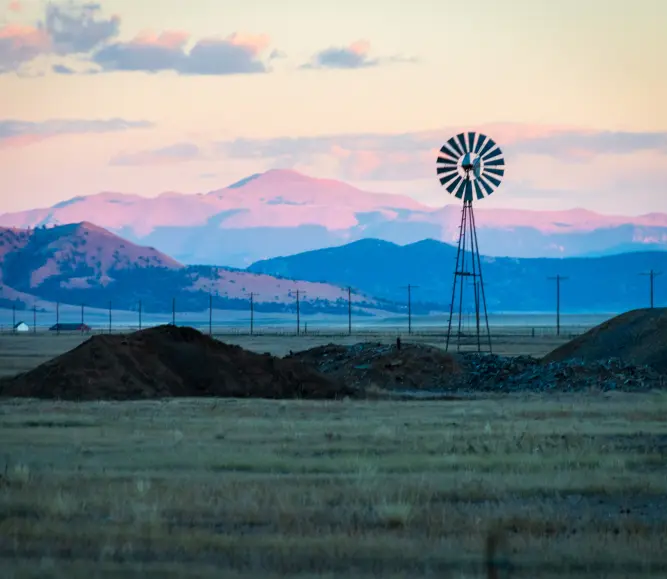
The state is awash in modes of energy generation. State policies starting in the 1970s and making great strides in the 1990s made the panhandle a leader in wind power generation. Geological work and the sacrifices of untold numbers of plants and animals thousands of years ago gave the region a wealth of natural gas and the nation’s largest oil field. The county’s second largest solar array is under construction outside of Amarillo, not far from the federal government primary nuclear decommissioning facility.
But the policies that make it all possible have roots in local soil.
“Counties understand something that is sometimes overlooked in national energy discussions,” Rural Action Caucus Chair Terry Wilbur said during a workshop on nuclear power. “Energy policy becomes real at the local level. It becomes the tax base that pays for roads, and every road that goes to it from that plant is a county road, plowed by the county. It becomes the employee who buys a home, it becomes the contractor who hires another worker. It becomes the family that depends on a good-paying job, it becomes the emergency management system that protects the whole county, not just the plant. It becomes the transmission line that delivers power where it is needed and it becomes the economic development opportunity that can help a rural community compete with the jobs and industries of tomorrow.”
Wilbur, who serves as Oswego County, N.Y. clerk, said that in his 17 years in county office, he had yet to hear residents voice opposition to the county’s three nuclear reactors, though he admitted that the mandated readiness drills could take some getting used to.
In addition to a dozen workshops and discussions, attendees toured two of the largest solar developments in the country in Swisher County, a large wind power development in Carson County and the site of a massive data center under construction in Armstrong County.
Battery storage
Whichever mode of generation a region chooses, battery capacity will be variable that makes everything work, but it’s dealing with an image problem that experts say is detached from reality on the ground.
The Moss Landing Power Plant fire in Monterey County, Calif. happened just two years ago, but Adam Capage feels the battery storage industry has moved far beyond world that existed during the two-day fire at one of the world’s largest lithium-ion battery storage factory. But the public’s long memory, and the difficulty they have keeping up with innovation in the field, could complicate buildout of a technology that could help communities meet power needs. Particularly when every flight they take includes a warning about lithium ion batteries.
Learn more
Energy Technologies and Siting Considerations: Battery Energy Storage System
“You all, in public meetings, are going to again and again hear reference to technology that’s seven or 10 years old,” said Capage, who is outreach and communications director for Renewable Northwest. “Pictures from moss landing are from the past, but they’re driving conversation in public policy today. And it really shouldn’t, because technology completely evolved from there,” comparing battery technology advances to artificial intelligence’s evolution.
Texas’s example would seem to back that up, with 99.5% of the state’s 22,000 megawatts of battery storage having been developed since 2020.
Mark Stover, executive director of the Texas Solar and Storage Association, pointed out that the annual increase in demand for power in the state would have only been satisfied by battery storage.
“We have diversity in the location of that fleet, and that matters. We have generation resources throughout Texas,” he said. “And batteries are dispatchable —they are the most flexible, fastest responding resource that we have on the grid.”
Meeting peak demand, Capage said, is all that matters for utility providers.
“The whole system, all the economics, all the design, all the market rules, all the concern and money it’s spent and debating all comes down to ‘Can we hit that peak,’” he said. “Because nobody is ever okay not having energy. We have to have electricity all the time. That’s the superpower of batteries.”
What has advanced the technology beyond the world of the Moss Landing fire is the nuanced composition of the batteries.
“Moss Landing was nickel, magnesium, cobalt, or NMC,” Capage said. “Today, everything is LIP. Lithium, iron, phosphate — completely different dynamics, chemistry, safety levels, heat level that it starts to burn at. So people sometimes conflate and say, just broadly, ‘lithium ion batteries, you never know what’s gonna happen. They burn for days, they, you know, they burned unreliably, et cetera.’”
Charlie Nichols, planning director for Linn County, Iowa, outlined how community engagement could take shape around ordinances guiding battery storage.
“You can have that community engagement process once you receive an application and people are concerned about it, engaging in your public process,” he said. “Or you can start your community engagement process before you have an application on the table and start thinking about what kind of requirements you would want to have in your zoning ordinance, before you’re trying to discuss requirements while well, also evaluating an active project.”
Oil and gas
If counties have learned one thing about oil and gas production, it’s that tax revenue from drilling is cyclical. Sometimes oil and gas are down and other forms of energy are up. Sometimes a particular region gets hot and the crews move on to work somewhere else. If counties want to avoid problems down the line, investing that money in infrastructure is generally a safer move than hiring staff.
“Don’t build permanent government on temporary commodities,” said Commissioner Steven Villela, who represents Midland County, Texas, in the oil-rich Permian Basin.
Even when the money is good, it doesn’t come without strings attached.
“You’ll be flush with people, with cash, but you also have a lot of demands on your hospitals, your sheriff’s department, law enforcement,” said Wise County, Texas Commissioner Kevin Burns, noting that the people who come to town to do the drilling bring their own demands for county services.
Diversifying an oil-and-gas-based economy for the long term?
“Man, I hate to be simple, but you can’t,” Burns said. “When it’s gone, it’s gone. Thankfully, when the exploration ends, there are still members of the communities who have to monitor and service that well.
“That keeps the cafes going and the hotels filled.”
Wind and solar
Stories of the death of renewable energy seem to be greatly exaggerated, so far, after the 30% federal solar tax credit ended following passage of H.R. 1. Though some projects were canceled in 2025 and 2026, the landscape is stabilizing as developers decide to continue without the tax credit.
“We’re at a weird nexus because we had accelerated sunsetting of policies that we were expecting to go for another half decade, at least. And yet, the industries haven’t necessarily collapsed,” said Charles Newcomb, technology director for Mana Group Consulting. “There’s a lot of fear at the beginning, a lot of anxiety, and then last year, there was a lot less.”
Learn more
Solar and wind developments continue to spread, thanks in large part to their lower cost and speed relative to a coal, oil, gas or nuclear power plant, and the speed.
The rise of agrivoltaics, a practice that combines agricultural and solar use, has helped to assuage some fears that solar development comes at the expense of farmland, as attendees saw during a tour of a nearby solar field.
Permitting bottlenecks and tariffs remain a challenge to solar development, according to Maren Taylor, director of regulatory affairs for the Solar Energy Industries Association.
“There have been these pendulum switch of swings over the last decade between tax credit support and no tax credit support,” she said. “I think what the industry is just sort of craving at this point is regulatory certainty.”
Nuclear power
After roughly 40 years of relative dormancy, nuclear energy is closing in on a new age as public perception improves with time. And Wilbur recognizes that the benefits to counties would go beyond just tax revenue.
“An existing nuclear facility can potentially become more than simply a source of electricity. It can serve as a platform for new energy technologies and new economic opportunities,” he said. “If we get the partnership right, nuclear energy can be more than an energy policy — it can be an economic development policy, workforce development policy, an infrastructure policy and a rural community policy.”
Learn more
The Oak Ridge National Laboratory was built in Roane and Anderson counties in Tennessee in 1943, it took a federally-coordinated effort by the Army Corps of Engineers to put it together for 600,000 people. With that history in mind, Roane County, Tenn. Mayor Wade Creswell noted that not many “nuclear friendly” communities have what it takes to support the scale of major nuclear development, at least not at the direction of the federal government.
“Not many of them are near population centers that can support the workforce challenges that we have, workforce demand, we’re going to have to stand up a supply chain that hasn’t existed in 40 years since nuclear went away,” Creswell said.
The private sector is going to be carrying much more of the weight in the new nuclear age, and Creswell is already seeing it in Tennessee, with dozens of startups angling to be the leader in handling 17 different steps in the nuclear life cycle, including reusing what had been considered spent fuel, applying technology planned for space to applications on earth.
“We’ve got two companies that are producing fuel for reactors that don’t exist yet,” he said. “That’s how far along this is.”
What will change this time is the size and scale of nuclear reactors. As small modular reactors come into focus with a standardized design and lower risk profile, because they would not reach the capacity necessary for a meltdown, they will be more adaptable for different communities and require less infrastructure, all while being able to power more specific projects.
Related News

The "Backslash Backlash:" Counties pivot in the data center buildout
Data center development across the country has put a new focus on county policies, how they regulate land use and more for local residents and how they could shape the path for economic growth built around artificial intelligence and information technology.

Chips, Compute and Counties
NACo CEO Matt Chase: "The fundamentals remain the same [when it comes to data centers]: demand a seat at the table, study the supply chain, understand the financing capital stacks, ask hard questions and fight for a deal that leaves your community better off — not used and abused."

Water matters for data centers
Data centers often cluster in a few places, need treated water and use the most when demand is already high in hot weather. This growing demand is driving data center development nationwide, accelerating local proposals and the importance for county officials to understand impacts to energy, land and water resources.
Featured Initiative
Rural Energy Academy