Energy Technologies and Siting Considerations: Wind Energy

Upcoming Events
Related News
Introduction
Wind energy is a form of renewable energy harnessed from wind flow. While the quality of the resource (i.e., wind speed profile) varies by location and altitude, recent advancements in wind technology have made wind energy cost competitive in more counties than ever. The economic competitiveness of wind energy has led to the installation of over 1,500 projects across the country, meeting more than 10 percent of U.S. electric power needs since 2022. For more county insights on energy topics, visit NACo’s Energizing Counties Resource Hub.
Wind Energy Technology
While most conventional energy systems (e.g., coal, oil, natural gas, geothermal) heat water and generate steam to turn a turbine, a wind turbine is moved directly by wind. Wind turbines are composed of large blades connected to a generator mounted on a tall tower. When wind blows across the blades they rotate, turning the generator, which converts mechanical energy to electrical energy. Wind turbine blades are long to capture more wind, and towers are tall to take advantage of stronger winds. They are getting longer and taller as technology advances. The average total height of a wind turbine under construction in 2025 is over 600 feet tall. Wind turbines operate autonomously and orient themselves to the wind, automatically generate power when there is sufficient wind and shut themselves down when wind speeds could be damaging. Wind turbines can be installed in small numbers but are more commonly installed in larger numbers to create wind farms to take advantage of economies of scale.
Wind Project Types
Wind projects are classified based on where they are installed and how they are connected to the grid.
Residential and commercial or industrial scale wind projects that are designed to meet on-site energy needs are connected to the grid through a net meter that records energy flow both to and from the grid. Any surplus energy is exported to the grid and pulled back as credits when there is a deficit, like on a calm day. Systems installed behind the customer side of the meter at distribution voltage levels are called behind-the-meter or distributed wind projects.
Community scale wind projects refer to locally initiated and owned wind energy developments where the ownership and benefits of wind turbines accrue to the local community, often through cooperatives, municipalities or farmer-owned groups. They can be connected at distribution or transmission voltage levels based on local interconnection policies.
Utility scale projects, located far from where the energy is used, are connected to the grid on the utility side of the meter (i.e., front-of-the-meter). These projects are not designed to serve on-site loads but are vital to the overall energy supply and grid stability. The energy is purchased by utilities and large consumers. Utility scale projects can be situated on land or on water (i.e., offshore). Offshore wind projects leverage vast, open waterbodies that allow for easier transport of large components like blades and towers and for accommodating extra-large wind turbines rated at 10 MW or more. Collected power is brought to land by underwater cables.
Siting Wind Projects
Utility scale wind developers prospect for project locations across the country and select sites to maximize project returns. These developers consider factors that include:
Wind Resource – Knowing a site’s wind resource is essential to estimating how much energy could be generated. The level of effort and investment in estimating the wind resource varies by project type. A desktop analysis is sufficient for a distributed wind project, while larger projects often require an 18-to-36-month study with site data gathered from a meteorological evaluation tower (often referred to as a MET tower).
Land – Land-based wind farms are most commonly located in rural areas with limited obstructions to wind flow. Wind turbines are spaced far apart to avoid turbulence from other structures, including neighboring wind turbines. While this spacing can result in wind farms covering many square miles, the actual land that is impacted over the long term by a utility scale wind turbine is about 0.25 acres per turbine, excluding the access road.
Interconnection – Wind farms include on-farm collection grids and project substations and are connected to transmission lines. Larger projects warrant interconnection studies that can take several years to process. While smaller projects may not require an interconnection study, all grid-tied projects must receive permission from the utility to interconnect.
Incentives – Developers target local, state or federal incentives and tax credits to meet investment hurdles.
Community acceptance – Developers often seek to site projects where residents are accepting of wind development on private or public land and may engage residents without input from local leaders. County leaders, elected to speak and act on behalf of their constituents, are well-suited to coordinate outreach and facilitate the discussion needed to assess and potentially foster community acceptance.
As these factors can influence developers’ desire to site in one location over another, counties may wish to assess each of them independently to make siting more attractive to developers. However, the current nationwide surge in energy demand may make even non-ideal land, interconnection and incentive structures economically viable to developers, opening up more opportunity for counties that may have discounted their resources.
County Considerations for Siting Wind Projects
Like any major infrastructure project, large wind projects create a variety of positive and negative impacts on surrounding communities. A comprehensive ordinance can ensure project benefits are shared equitably and negative impacts are minimized. This task can be challenging for counties without zoning authority, but county leaders can still promote a healthy relationship between the developer and residents through active collaboration with state and federal regulators. Key issues for county officials in collaborating with developers and drafting wind development ordinances include:
Economic Impact – Distributed wind projects can benefit local consumers by helping to control their energy costs. For utility scale projects, landowners can receive land lease payments (which are often higher than farming revenues in rural areas) and project owners receive payments for energy sold and potential tax credits. Counties and local jurisdictions can expect to receive tax revenue from these projects; however, federal and state incentives for energy projects in the form of property tax abatements can often impact county revenues. County leadership can support residents by ensuring the appropriate benefit-sharing mechanisms are chosen. One effective strategy is negotiating host community agreements with developers for equitable sharing of project benefits.
Land Use – The combination of small footprint and wide unit spacing allows landowners to continue using the land under and around wind turbines.
Visual Impact – The height of wind turbines makes them visually noticeable structures. Wind towers and blades are painted white to be less intrusive and blend with the sky. Every community has a unique landscape and character that must be considered at the local level to ensure long term community buy-in for projects; however, it is often necessary to make them more visible for safety reasons. For example, Federal Aviation Administration requires lighting to signal aircraft, and painted blades reduce wildlife collisions.
Workforce Development – In the short term, on-site construction labor provides opportunities for local tradespeople. While many jobs are created during the construction of the project, contractors often bring experienced laborers in from outside the community. County leaders can create employment opportunities for residents by requiring local labor engagement. Local trade schools and community colleges can develop energy-based curricula to meet demand for longer-term employment. An active wind industry benefits from a local workforce for continued project operations and maintenance support for the life of the project.
End of Project Life – Turbines have an initial design life of 20 years. Towers, foundations and wind farm electrical infrastructure are designed to last much longer, which allows for extending the life of a successful project if all stakeholders agree. Requiring a comprehensive decommissioning plan that evaluates repowering options can maximize community benefits and minimize impacts. The plan can also require a decommissioning bond or other financial instrument built into the project budget to return the site to its original condition at the end of the project.
Safety – Wind turbines combine advanced structural and electrical engineering principles with detailed design requirements covered by the International Electrotechnical Commission (IEC) and is updated on a regular cycle.
Public Perspective – Active community engagement with accurate information can help address misinformation and ensure equitable community growth.
Local Infrastructure – Large wind turbines have unique transportation and logistics needs since heavy or long turbine parts and large cranes must be delivered to the site. While the bulk of large component delivery occurs during construction, large components may need replacing through the project life. County leaders can require a detailed transportation study from developers to help prepare and can negotiate with developers to ensure that any necessary road upgrades or repairs are made by the developer.
Wildlife Impact – Large construction projects like wind farms can have adverse effects on the local ecosystem both during and after construction. In addition to compliance with federal environmental regulations, coordination with local and state environmental conservation programs is essential to address impacts to native and migratory species and develop appropriate mitigation measures.
Frequently Asked Questions About Wind Energy
What is the difference between a windmill and a wind turbine?
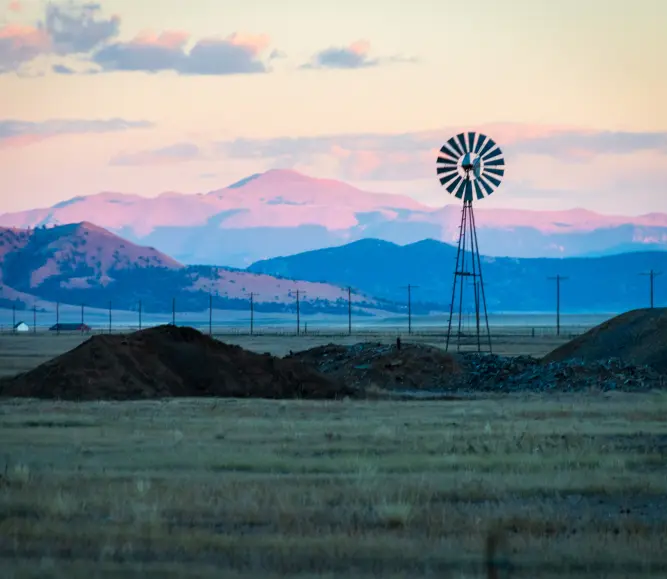
A windmill is a mechanical device that converts the power in the wind into mechanical energy to grind grains or pump water. Wind turbines convert power in the wind to electricity.
Can wind turbines be installed on existing buildings and structures?
Wind turbines can generate forces that traditional buildings are not designed for. There are examples of wind turbines being incorporated in prominent buildings, but this is very rare.
Can wind turbines and associated parts be recycled?
Over 90 percent of the mass of a wind system is composed of iron and steel found in tower, foundation, drivetrain and other parts – these parts can be recycled locally. Other materials like fiberglass in the blades and housing or rare earth magnets in some generators require newer recycling capabilities.
Are wind turbines noisy?
Under normal operating conditions the wind turbine will sound no louder than a household refrigerator. Abnormal, unusual ambient conditions can arise that cause the turbine to sound louder for short periods of time.
Do wind farms lower property values?
Recent studies have found that wind projects lead to economically meaningful increases in district-wide housing values of approximately 3 percent when those values are compared to similar homes located in school districts in same-county without wind energy.
What is shadow flicker?
Shadow flicker is the moving shadow of a wind turbine blade. Health concerns from shadow flicker for individuals with photosensitive epilepsy is a commonly cited concern. Shadow flicker is controllable and predictable, and a shadow flicker study is often mandated by wind zoning ordinances. The limited impact can be further mitigated by siting turbines carefully.
Intended Use:
This content is intended for educational purposes only. The National Association of Counties (NACo) supports policies and programs that equip county governments with the resources and flexibility needed to serve our residents. NACo does not endorse any particular strategy or approach shared in this resource over another. For official NACo positions, please refer to the American County Platform.
1 Hoen, B.D., Diffendorfer, J.E., Rand, J.T., Kramer, L.A., Garrity, C.P., and Hunt, H.E., 2018, United States Wind Turbine Database V8.1 (May 22, 2025): U.S. Geologi-cal Survey, American Clean Power Association, and Lawrence Berkeley National Laboratory data release, https://doi.org/10.5066/F7TX3DN0; U.S. Energy Information Administration. Electricity data browser - Net generation for all sectors. Accessed October 22, 2024. https://www.eia.gov/electricity/.
2 International Electrotechnical Commission. https://www.iec.ch/homepage
3 Eric J. Brunner, Ben Hoen, Joe Rand, David Schwegman, Commercial wind turbines and residential home values: New evidence from the universe of land-based wind projects in the United States, Energy Policy, Volume 185, 2024, 113837, ISSN 0301-4215, https://doi.org/10.1016/j.enpol.2023.113837.
Featured Initiative
Energizing Counties Resource Hub
NACo empowers counties with the tools and resources needed to consider and facilitate energy projects best suited for local communities. NACo is developing resources and tailored guidance to assist local governments in navigating the opportunities and challenges of different energy industries.

Featured Initiative
Rural Energy Academy