Energy potential comes into focus for rural counties


Facing long-term development, permitting and construction timelines for new large power plants, the United States is looking for volunteers to help relieve the growing domestic power crunch.
Plenty of arms are raised in Sherman County, Ore.
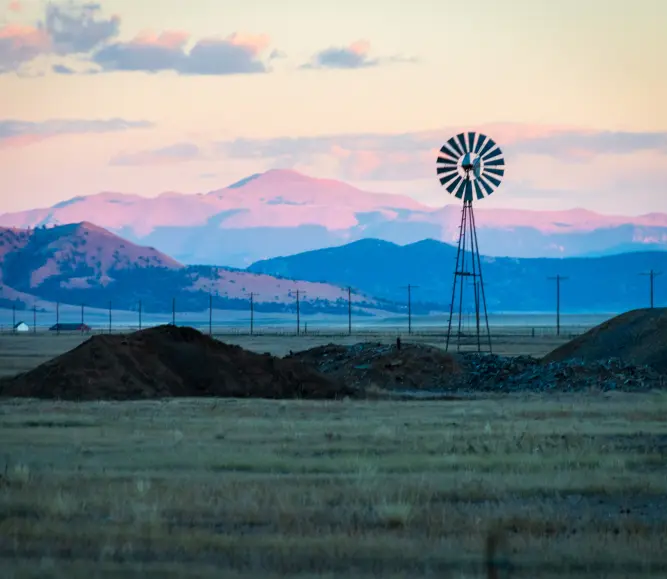
They stretch 400 feet into the sky and are generating more than 800 megawatts of energy for regional power companies and changing the county’s economic outlook as turbines spin in the wind. Solar farms augment the wind farms’ output.
Each household in the county receives a $590 Resident Incentive Program check each year due to the state’s Strategic Investment Plan with power companies, and the county’s courthouse, fairgrounds and school campuses have all benefited from energy-related payments.
But 20 years ago, before wind and solar energy proliferated, the county’s vehicle fleet was buying used tires from other local governments, one of many cost-cutting measures that were standard for a county ranked in the bottom two for income in the state.
“We had no industry,” said County Judge Joe Dabulskis. “Most of the land was used for growing wheat, a little bit of barley and some cattle.”
As the national debate over energy policy and the future of a secure and stable domestic supply of electricity forms, counties have a voice when it comes to the siting and public benefits of these projects, primarily wind and solar power.
It’s a future Dan Looten pondered growing up on a Carson County, Texas farm, decades before he became judge of the Commissioners Court.
“I can’t tell you how many times I’d heard people say, ‘If we could just make money off this wind, we’d be rich,’” he said. Now, Carson County is home to 700 turbines, which get a lot of work in the windy Texas panhandle.
Carson County receives another variation of benefits — Payments in Lieu of Taxes — which helps the county get a handle on more predictable payments over the course of the agreement.
“That helps us smooth out our budget,” Looten said.
The benefits generated by those wind farms helped the county pay off the bonds for a new jail nine years early, saving more than $400,000 and cutting the sales tax passed to finance the jail.
Although the county looks toward more wind farm development and potential small modular nuclear reactors planned to power a large data center that is in the works, Looten doesn’t see the benefits payments entirely replacing property taxes, but he does anticipate energy development allowing the county to lower them while fortifying the budgets of first responder agencies and other public resources.
“Our population has been dropping as people move to larger cities, and our smaller communities are shrinking and are struggling to maintain some basic infrastructure like water and sewer and the quality-of-life amenities,” he said. “Those payments can help support those communities.”
These projects aren’t immune from criticism. The height necessary to optimize the wind makes them visible far from the landowner’s property, and as small- and medium-sized farms see a precipitous decline (Sherman County’s 90 farming families decades ago have dropped to 40), alternative uses become an easy scapegoat. Dabulskis is a convert, and not just because of the land lease payments available to land owners who play host to energy developments.
“Up until 10 years ago, I was a farmer out there and I was not supportive of the renewable energy,” he said. “I didn’t want to see it. It blocked my views of Mount Adams across the river. Somebody put it this way: ‘It’s taken me quite a few years not to see the wind turbines,’ but I also can’t imagine the county having to make tough calls on every expense.”
The annual $590 check helps soothe viewshed concerns.
Dabulskis hears disparagement that the electricity produced by local wind and solar farms is exported elsewhere. He counters that Sherman County wheat is mostly exported to Pacific Rim countries.
Other critics warn of displacement of farmland.
Dabulskis cites a farm with 14,000 acres, which, after construction of turbines, roads, a maintenance building and an office building, totaled 39 acres from production, two-tenths of a percent of the overall farmland.
While opining on the promise of hydroelectric power in 2000 while campaigning for the presidency, then-Gov. George W. Bush, whose administration in Texas seeded a boom in wind energy development, was widely quoted: “I know the human being and fish can coexist peacefully.”
Now, farmland owners are finding their renewable energy infrastructure is compatible with their livestock. Cattle can coexist with turbines and sheep manage well around solar panels. Renewable energy and agriculture are not mutually exclusive.
In addition to the benefits available to counties through benefit agreements, counties also can see an increase in construction jobs to support deployment of turbines and solar fields, which can prompt closer coordination with community colleges and trade schools and with both solar and wind technology projected to have a 20-year useable life, the decommissioning work schedules itself.
The land use authority granted to counties varies by state — Oregon allows solar, along with 51 other uses, on agricultural land. That gives counties different leverage when it comes to regulating energy projects, though some state legislation is seeking to preempt county land use authority in states like Arizona and Maryland.
Looten recommends using abatement agreements to mitigate other negative externalities beyond the viewshed complaints.
“The most important thing is to anticipate the conflicts and get ahead of them in abatement agreements,” he said. “Good fences make good neighbors. We have a solid fence line here.”
Related News

Water matters for data centers
Data centers often cluster in a few places, need treated water and use the most when demand is already high in hot weather. This growing demand is driving data center development nationwide, accelerating local proposals and the importance for county officials to understand impacts to energy, land and water resources.

County leaders push for a voice in data center regulation authority
County officials in states like West Virginia and Texas are limited in their ability to regulate data centers while still held accountable by their residents.

The "Backslash Backlash:" Counties pivot in the data center buildout
Data center development across the country has put a new focus on county policies, how they regulate land use and more for local residents and how they could shape the path for economic growth built around artificial intelligence and information technology.
Featured Initiative
Rural Energy Academy