Tumultuous ’80s test NACo’s fundamentals


Key Takeaways
During the late ’70s and early ’80s, NACo shifted in a more entrepreneurial direction, establishing a deferred compensation program to aid county employees in their retirement and entering the real estate market. The fate of the two would diverge.
While Dallas County, Texas negotiated a deferred compensation program for its employees, Commissioner Roy Orr, then NACo’s president, saw potential for smaller counties to adopt a national retirement plan. The executive committee decided on the Public Employee Benefit Service Corporation (PEBSCO) as a plan administrator, a business that was already serving several states and the U.S. Conference of Mayors. Within a year, 400 counties had signed, and counties and state associations would share in proceeds. In 1999, PEBSCO was acquired by Nationwide Retirement Solutions.
Learn more
It also put NACo in business with Oklahoma financier David Davenport, PEBSCO’s founder, who took a shine to county officials. He had pushed for changes to the tax code to create deferred compensation retirement plans for government employees. He also endowed an annual college scholarship for a student graduating from a high school in the NACo president’s county, along with mentorship for the student.
“He saw what 401(k)s could do for the private sector and asked why public sector employees didn’t have that,” said Larry Naake, who was back on NACo’s staff again in the early ‘80s. “He was the leading force behind getting that through Congress.
“He had a genuine appreciation for our members and often went out of his way to keep in touch with them and reach out if they were having difficulty.”
Meanwhile, an $11 million construction project at 440 First St., NW in Washington, D.C. would culminate in a 100,000 square foot, eight-story building, two floors of which NACo and its more than 150 staff members would occupy, with a penthouse designed for events and entertaining. Rent revenue from subleasing the lower five floors, which would be NACo’s responsibility, would cover overhead expenses, including $1.5 million in projected annual rent, and the cost of construction. NACo would take on the lease for the entire building.
Vice President Walter Mondale attended the Dec. 18, 1980 groundbreaking and Vice President George H.W. Bush gave the address at the Feb. 24, 1982 dedication, along with speeches by Senate Majority Leader Howard Baker (R-Tenn.) and House Majority Leader Jim Wright (D-Texas).
Contrasting with the contemporary exterior, the lobby evoked a 19th-century county courthouse, with terrazzo floors and a domed opening in the ceiling. A wall bore individually engraved bronze plaques with the name and seal of each of America’s counties.
But by the time the building was complete, the market for office space in Washington, D.C. was cold.
Budget crash
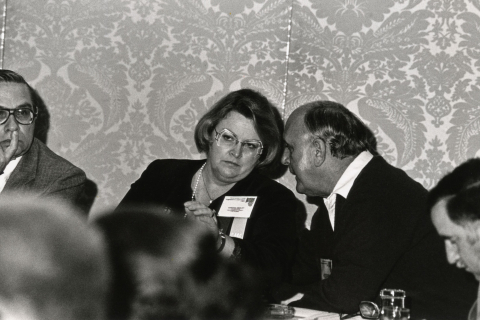
A month into his NACo presidency in August 1982, Rensselaer County, N.Y. Executive Bill Murphy was entertaining Pennsylvania county officials for lunch when the waiter whispered that his NACo American Express Card had been declined. Murphy offered him his backup Visa card, but he was told he was “two for two.”
“I thought, ‘Uh oh, something is going on here that I am not going to like,’” he recalled.
This followed a clean audit report just weeks earlier, but Murphy called accounting firm Peat Marwick to scrutinize the association’s situation. After that assessment, the firm’s principal told Murphy to pour himself a stiff drink.
NACo had a $2.26 million budget deficit. Few knew it then, but it would take NACo 15 years to emerge fully from what was happening and 25 years to leave the building that caused so much heartache.
“It’s worse than that because your building is draining all of your resources, and resources have been diverted,” the accountant told Murphy. “This was operating money that was being diverted into other things. It’s not sustainable.”
Over Labor Day weekend, NACo’s executive committee met to figure out the crisis and how to shift the organization. At a White House press conference that week, a reporter spoke privately to Murphy about the situation, and Murphy offered him an exclusive interview on the issue in exchange for a delay in publication, winning the chance to tell NACo members about the crisis himself.
The leases for the lower floors of the building? Only one had an actual commitment, the American Management Association, and beyond that, the auditors had taken the word of NACo’s financial staff rather than asking to scrutinize lease documents that did not actually exist. Those staffers were fired, and Hillenbrand, the executive director who took the organization from a hotel laundry room to a mainstay in the halls of Congress, resigned after 25 years leading the organization.
Getting approval for loans to keep NACo operating required dramatic action. Of the 118 staff members in August, only 51 remained in September.
“Let me tell you, it was a very painful time for me,” Murphy said. “I knew those people very well. I had been on the NACo board for five or six years before I became president. I knew some of the people that we were having to personally deliver pink slips to. It was very hurtful, very difficult. Of course, your relationship changes with people when you’re not giving them a job anymore, and you go from being a friend to being an avowed enemy.”
Davenport personally loaned NACo $400,000 to satisfy operating expenses, with PEBSCO offering a similar amount. Davenport also helped Murphy negotiate partial repayment of outstanding bills. State associations loaned NACo $10,000 apiece, and members advanced a year’s worth of dues, on top of a dues increase.
Murphy said that the siloed organization that permeated NACo at the time made it harder for the problems to be apparent.
In the meantime, PEBSCO loaned executives James Marshall and Ron Cameron to manage NACo until the executive committee hired a successor to Hillenbrand.
“I asked Jay Wilkinson, who was the president of PEBSCO, if he could loan me Jim. I said I wouldn’t need him for more than a few weeks, but that was a lie. He stayed for four months,” Murphy said. “Those two guys were instrumental in helping pull the monkey off my back of having to deal with this stuff literally on a day-to-day basis.”
By April 1983, a sense of normalcy returned to NACo as its new executive director settled in after a few months on the job. Matt Coffey came to NACo steeped in financial know-how, having previously served as CFO of Textron Inc., and he was familiar with NACo after serving as a special assistant to both President Johnson and Carter. At 6 foot 8, he was hard to miss. He brought a pragmatic perspective to an organization in need of steady leadership.
“It’s going to take 24 to 30 months to work our way out of the hole,” Coffey said upon his hiring in 1983.
Murphy said Coffey pulled NACo out of a financial tailspin and allowed it to get its bearings, though the necessary austerity limited how wide NACo could reach.
“He did a good job in setting up the structure that would cause us to be able to move forward,” Murphy said.
Sandy Smoley, Murphy’s successor as NACo president, also helped with that. As the only Republican on the Sacramento County, Calif. Board of Supervisors, she often found herself on call for events with Gov. Ronald Reagan. The two struck up a friendship that she later drew on to help his presidential reelection campaign staff find office space downstairs from the NACo staff. That rental revenue was crucial to NACo’s solvency for the next two years.
“Bill Murphy did all the hard work keeping NACo together. Then the next year I got to travel around the country, kissing and hugging everyone and thanking them for helping us survive,” she recalled in 2024.
Counties in Virginia and Maryland lent their fiscal staff to help bridge the gap between the staff NACo could support and the work that needed to be done.
Murphy also had to play hardball with some vendors. NACo had leased, for $100,000, three heavy-duty photocopier machines, “each capable of serving the Library of Congress,” he said. “They were a tremendous oversell by the company.”
Negotiations with the company’s sales consultant were slow going.
“I told him we needed to break the contract, and he told me they didn’t break contracts for anybody,” Murphy said, advising the consultant that it was time to make an exception.
“Unless you know our president, don’t even think about it,” he was told.
Murphy told him to get his trucks ready, then retreated to try and figure out how to back up his bluff. He called a fellow county executive, asked out of the blue if he knew the company’s president, and it turned out the executive golfed with him regularly.
Shortly after, the sales consultant expressed amazement that Murphy was able to break the contract. “That’s the army of county government,” Murphy said. “We stick together.”
Renewed focus
With a bank loan secured, Murphy and the executive committee needed to figure out where NACo would ultimately go from there. They asked members:
• Is NACo important to you?
• What do you want from NACo?
The answer that resonated the most was to have better government affairs efforts. Despite a two-thirds cut to the NACo staff, the legislative affairs department added three lobbyists to the previous six and focused on being the voice of counties.
But the most powerful response came from Shelby County, Tennessee Mayor Bill Morris.
“I asked him, ‘Should we just shut this down?’” Murphy said. “‘Should we just get rid of NACo and just have the American Association of Counties and clean the slate already?’ He said, ‘No, my advice to you would be to stay and fight. Let’s just do what we need to do to clean this up and get it back together because you’ve got a position that’s been around for decades. And we’ve got people that know us. We don’t want to start fresh with somebody else.’”
While NACo was able to pull together friends and influence to stay alive, the following years were marked by severe austerity for the organization. Counties, too, suffered a loss three years later when General Revenue Sharing met its demise after winning a reprieve in 1983.
“We were preparing for that,” said Kitsap County, Washington Commissioner John Horsley. “We were able to make the transition with some tough, but not fatal, adjustments.”
After helping stabilize NACo, reaching settlements with 323 creditors and establishing accurate membership records, Coffey moved on to the National Tooling and Machining Association, and NACo in turn hired John Thomas.
Thomas had been working as executive director of the Florida Association of Counties as the organization tried to shift toward more involvement from the state’s urban areas after being dominated by rural counties. He worked at NACo on a county modernization grant from the Ford Foundation in 1972 after his college roommate, then a NACo intern, recruited him. Hillenbrand recommended he take the Florida job but told him there was always a place for him back at NACo.
“Bernie let me work on my doctorate while I was working at NACo. I’m not sure I would have finished it otherwise,” Thomas said.
While in Florida, Thomas started organizing the state association executives on an annual basis, a precursor to the National Council of County Association Executives.
It was a challenging transition for Thomas, given NACo’s situation.
“The first six months were an absolute nightmare, of all the issues constantly coming forward,” he said. “I said to a couple of my friends that I thought I was coming back to help continue to modernize government, but 90 percent of my time I was doing either insurance or real estate work, trying to fill a building. But that was what we had to do so we could get back to the business of county government.”
NACo did fill the building, with the American Israel Public Affairs Committee, which funded a significant security upgrade, along with a popular sandwich shop.
“I have to say, sometimes you just plain get lucky,” Thomas said.
He had been a skeptic of insurance programs for associations, worrying that they would remove an incentive for members to invest in the organization, but he was glad to be wrong when NACo’s insurance program allowed the organization a revenue stream to pay down its debt.
“I would have loved to have taken 10 percent and put it into programs, but the Board was firm on paying off our debt,” Thomas said. “You have to get out of debt to have any credibility.”
NACo was also able to rebuild its research and program capacity with grants, contracts and foundation money. An increase in urban membership, like Thomas had orchestrated in Florida, brought additional dues revenue.
“We were able to hire the kind of people that I thought we really needed to be cutting edge,” he said.
The 1980s were a rough time for counties themselves. The nation was facing its worst recession since the Great Depression, and as a result the demands on county social services increased dramatically. Decreasing property and sales tax revenues further stressed county budgets.
“In 1986 and 1987, the federal government was scaling back on assistance to counties and cities but our burden, especially in mental health and social services, was growing,” Horsley said. “We were between a rock and a hard place. We’re losing General Revenue Sharing. We’re losing federal grants in general, but the burdens in the suburban governments were increasing.”
Though both served relatively short tenures, Coffey and Thomas each faced a tough task helping NACo through its transition. Coffey was more financially oriented but lacked experience working with a membership organization or county officials, and while Thomas didn’t care for the financial matters, he thrived on engagement with county officials.
“I found in Florida that if you could get wins for the rural counties, they’d support efforts that benefitted urban counties,” Thomas said. “We held on to that strategy to keep our advocacy efforts balanced.”
Combined with the reinvestment in the legislative affairs staff, Thomas helped reorient NACo toward the intergovernmental affairs work that made the organization unique.
“Hiring John Thomas was one of the best moves we made in that decade because he just turned out to be a superb leader,” Horsley said.
Members of the executive committee started making regular trips to Capitol Hill, a major initiative led by President Ann Klinger, a Merced County, Calif. supervisor.
In 1991, Thomas decamped for the American Society for Public Administration, where he could resume his academic interest in government.
“I was able to leave feeling like I had given back,” Thomas said.
Related News


Dunlap Takes Office as National Association of Counties President
Mecklenburg County, North Carolina Commissioner George Dunlap was sworn in as president of NACo on July 20 at the conclusion of NACo’s 91st Annual Conference in Orleans Parish/New Orleans, La.

Astronaut, Purple Heart recipient to keynote NACo Annual Conference
More than 3,000 county officials and others will converge on New Orleans this week for NACo’s 91st Annual Conference & Exposition, where the nation’s counties will set their federal policy agenda and elect new leadership.
County News
Podcast: NACo at 90 preview
NACo Executive Director Matt Chase interviews County News Podcast Host Charlie Ban about a new book chronicling NACo’s first 90 years.
