Reimbursement policy prolongs disaster recovery for counties


Key Takeaways
Long after flood waters are gone, many counties are still left under water when it comes to recovery costs.
And while they are busy removing debris and rebuilding infrastructure and facilities to return to normal, the daily work of county government continues. It can take years, or decades, until the full reimbursement arrives from the Federal Emergency Management Agency’s (FEMA) Public Assistance Program.
“The first contract that we signed with [disaster recovery contractors] was $10 million. Then we went to $20 million, then to $40 million,” said Avery County, N.C. Commissioner Dennis Aldridge. “Every time you’re in a meeting and you put your name on that document like that, it’s pretty intimidating.”
All told, Avery County spent months recovering from Hurricane Helene waiting for a $57 million reimbursement from FEMA for debris removal, all while managing the Western North Carolina county’s annual budget of $42 million.
“We chose a private contractor, rather than the Army Corps of Engineers, because we felt it gave us a little bit more control over using local people” amid the federal government’s disaster recovery regulations, Aldridge said. “If we’re going to be spending this huge among of money, we’d rather have the work go to local contractors.”
And the reimbursement delays put the county in a challenging position with those contractors.
“We began to take about $2 million a month out of our fund balance just to keep the wolves from the door, just to allow the contractors to make some interest payments,” he said. “It’s not the people that are the problem [at FEMA], it is the process. They can only work within the process that they’re given, and this model of presenting the proposals, and you have to have all the documentation, and we have learned that ‘approval’ does not always mean ‘approval’ in the long term.”
Avery County’s administration building was flooded, forcing county employees into temporary offices. The senior center, EMS center and the county’s baseball field were all destroyed.
“We used county money, not FEMA money, to buy a restaurant so we could keep Meals on Wheels going,” Aldridge said. “After the first week, we haven’t missed a day of providing food, even if we can’t do large congregate meals in what’s become our senior center.”
Alridge knows that moving ahead without FEMA approval can jeopardize a project’s eligibility for reimbursement, but nearly two years after the hurricane, residents are losing their patience.
“Whenever nothing is getting done, you’re quite aware of how the people are looking around, and they ask why nothing is happening, why something isn’t being fixed,” he said. “When we say we can’t, that our hands are tied until we get the go-ahead, that makes us look pretty ineffective.”
With the county’s contractors awaiting payment, Avery County has paid when it can and negotiated partial payments for other services. And officials try to appeal to members of Congress to expedite the process.
“We’ve learned that we have to be the squeaky wheel to get the federal money,” he said. “I joke with our interim county manager that whenever our federal delegation sees us on a Zoom call, they know what we’re going to talk about, because we’re pretty adamant about it, and we hold them to it.
“I’ve had to be probably more vocal than I would have liked to have been, but we just feel we can’t quit. We can’t give up.”
There’s some hope for a new path forward. That process would change under the bipartisan Fixing Emergency Management for Americans Act (FEMA Act), which would change the current reimbursement model for public assistance into a grant program. The bill would also set funding deadlines and introduce a flexible cost share that’s tied to mitigation measures, along with streamlining environmental and historical reviews that delay projects.
The Individual Assistance program would also change under the FEMA Act, adopting a universal disaster application and offering other flexibility that would help homeowners navigate bureaucracy.
The FEMA Act passed the House Transportation and Infrastructure Committee by an overwhelming margin of 57-3 and is awaiting action on the House floor.
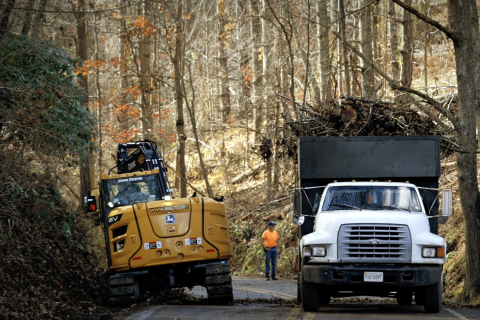
Adding to the administrative headaches throughout the process since Helene hit the Blue Ridge Mountains in 2024, Avery County lost its county manager to health concerns, followed by his interim substitute’s retirement.
To earn reimbursement to rebuild the county administration office and the senior center, the county had to perform a time-consuming cost-benefit analysis, and while the federal government was looking for 51%, the magic threshold that demonstrated the move was justified, Aldridge was satisfied with one number: 3.
“The senior center has been flooded three times already,” he said. “I’m not too smart, but I think a wiser move would be to put it somewhere else.”
While Congress continues to work on the FEMA Act, counties will receive more clarity on pending reimbursements. In April, the Department of Homeland Security appropriations bill required FEMA to publish an interactive, publicly accessible dashboard tracking all requests for reimbursement under the Public Assistance program. It requires FEMA to post reimbursement request data no more than 90 days after receiving it, and within 60 days of a project entering final review at the Department of Homeland Security. The dashboard must include project-level detail, including cost estimates, applicant identifiers, submission dates, project descriptions and the federal and non-federal cost-share breakdown for every grant.
Related News

Post-Disaster Protection Act advances through the House Transportation & Infrastructure Committee
On Sept. 15, the House Transportation & Infrastructure Committee passed the Post-Disaster Protection Act (H.R. 8409), favorably reporting it to the full legislative body for consideration.

NACo submits comments on proposed CDBG-DR formula change
NACo submitted comments to the U.S. Department of Housing and Urban Development (HUD) on its notice proposing changes to the CDBG-DR formula, the methodology HUD uses to calculate disaster recovery allocations to states and localities

Webinar
Unlocking Federal Reform: What the FEMA Act Means for Counties
Join NACo for a national membership call to learn about the newly released FEMA Act and its potential to transform how counties prepare for, respond to and recover from disasters.
