NACo pivots to data, problem solving in 2010s


Key Takeaways
Approaching Larry Naake’s retirement in 2012, an executive recruitment firm tasked with finding his successor pursued Matt Chase, then the executive director of the National Association of Development Organizations.
Chase was raised by a Washington County, New York district attorney and judge and a mental health professional and brought fresh federal government affairs experience to the job. “Matt wanted to make NACo the place to go for information, the source nationwide for data on counties,” said Lenny Eliason, an Athens County, Ohio commissioner who was NACo president while recruiting Chase. “We had been an information clearinghouse, but he saw an opportunity to enhance our credibility by being more assertive, really becoming a leader in the ideas marketplace.”
NACo fortified its research department, which compiled reliable statistics ranging from the proportion of county-owned roads (44%) and bridges (38%) to the share of the U.S. workforce comprising county employees (2%). Steering committees took a more active role in recruiting members who overlapped with congressional leaders in relevant committees.
“We wanted to put a human face on the services that counties are providing, and these are our neighbors, these are our family members, these are our friends,” Chase said. “Counties are about community. We’re not just about dollar figures, physical assets and courthouses.”
The overall effort helps to illustrate the scope of the work counties do, the people involved in their governance and administration and the extent to which county governments have authority to enact policy.
The data analysis added up to the County Explorer, an interactive website displaying a dizzying array of county-level data.
Policy development evolved to policy advancement, following member-driven initiatives to demonstrate counties’ willingness to generate ideas and readiness to take charge and address their own issues. They wouldn’t wait for Congress to make things happen.
Stepping Up
In 2002, Ken Mayfield, a former assistant district attorney for Dallas County, Texas and chief of its juvenile detention division, brought attention to the expediency with which law enforcement would treat people who were suffering mental health crises, both in testimony to the Senate Judiciary Committee and as a focus of his NACo presidency beginning that year.
“Too often, they just arrest them and take them to jail, and then they don’t have to deal with them anymore,” Mayfield said. “You know that wouldn’t lead to the best outcomes for those individuals or for society.”
He had organized a community-based task force in Dallas County to create a comprehensive diversion program to keep people with mental illness out of jails. Ten years later, Douglas County, Neb. Commissioner Chris Rodgers took up the cause with his Smart Justice presidential initiative, seeking to reform judicial policy to relieve counties from the bulk of pretrial detention for nonviolent offenses.
When Chase arrived for his first day at NACo, he was met with a tall stack of letters on his chair, mostly from bail bond agents excoriating Rodgers’ initiative.
“That really motivated us to stick with it and what eventually became Stepping Up,” Chase said. “Most of the individuals with mental health illnesses actually are the victims, not the perpetrators.”
The Stepping Up initiative launched in 2015 in collaboration with the Council of State Governments Justice Center and American Psychiatric Association Foundation, calling for counties to commit to working with leaders in their communities, judicial systems, treatment providers and more to take concrete steps to divert people with mental illness from incarceration. Four different kickoff events, in Miami-Dade County, Fla.; Johnson County, Kan.; Sacramento County, Calif. and Washington, D.C., emphasized the plight suffered by an estimated 2 million people who were incarcerated at the time.
It also demonstrated a new tactic NACo was taking to address counties’ needs.
“It shifted the focus from begging the federal government to engage with us to saying, ‘We’re going to continue to ask federal and state partners to help us, but we’re not going to wait,’” Chase said. “We’re going to get judges, prosecutors, public defenders, sheriffs, county commissioners, our community partners and we’re going to take it upon ourselves to make progress.”
The initiative followed the example of Miami-Dade County, Fla. Administrative Judge Steve Leifman’s pioneering work directing people in mental health distress toward resources that will help them receive the treatment they need while also making better use of resources counties are otherwise spending on jail operations and expansion. Leifman’s work was elevated by NACo’s LUCC Chair Sally Heyman, a Miami-Dade County commissioner.
“The cost to local county governments, because of not treating this population, is so exorbitant,” he said in 2024. “It’s almost mind boggling. I think if taxpayers understood how many billions of dollars were getting wasted by not treating people, they would be stunned, and we might be able to actually fix the problem.”
In addition to the pretrial services, Stepping Up has also emphasized the importance of crisis intervention training for law enforcement, equipping responding officers with the know-how to de-escalate situations with people experiencing mental health crises.
“We’ve just seen tremendous buy-in and great results, including sheriffs and law enforcement being our champions,” Chase said.
Ten years in, more than 600 counties have committed to Stepping Up, and 54 counties have been recognized as “accelerators” for their sophisticated, comprehensive efforts to reduce the number of people with mental illness in their jails.
Close partners
In 2016, NACo moved again, this time to the adjacent building located at 660 North Capitol St., NW. Co-located with the National League of Cities, the building includes a joint conference center, which has allowed NACo to play host to an increasing number of briefings, conferences, peer exchanges, confabs, discussions, dialogs, debates and meetings.
Facing the opioid epidemic
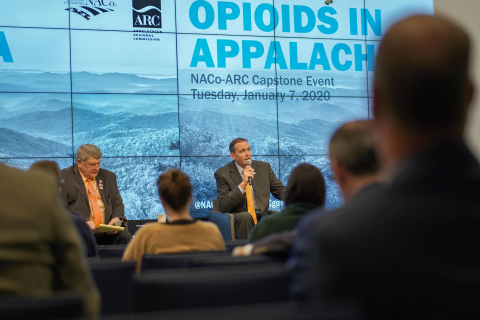
In 2009 and 2010, counties started taking action to limit “pill mills,” clinics that prescribed opioid-based painkillers with little or no diagnostic effort or corroboration. These clinics were often the refuge of patients who received prescriptions for medicine that was advertised to be nonaddictive, then found out those claims were inflated and were desperate to avoid withdrawal symptoms.
Those efforts were too late to stem the increase in Americans suffering from substance use disorder because of their prescriptions. By 2016, drug overdose was the leading cause of accidental death in the United States, and counties were seeing those results manifest across the services they provided.
First responders were finding more and more residents suffering overdoses, and for many it would be years before they had access to treatment to stop those overdoses. Failed drug tests had become major contributors to unemployment. Coroners and medical examiners saw added caseloads when overdoses became fatal. Child and family services were stretched thin when parents died or were unable to care for children.
Much like the mental health crisis, options for treatment were dramatically limited by the number of providers, which was almost always far less than the demand. And when supply crackdowns made it harder and more expensive to obtain prescription drugs, users would divert into heroin and later synthetic opioids like Fentanyl, which posed even greater risks of overdose.
In 2016 NACo and the National League of Cities formed a joint opioid task force to examine the intergovernmental solutions to the issue, analyze best practices and offer policy prescriptions.
Boone County, Ky. Judge-Executive Gary Moore, who later served as NACo president, was NACo’s co-chair for the task force and saw the effects of the epidemic in his home county.
“My greatest surprise was how physicians that were trying to find solutions to pain management had bought into the fact that opioids were not addictive and that they were safe,” Moore said.
Soon, counties were seeking legal relief from the consultants, manufacturers and distributors of these painkillers, arguing that not only were they improperly marketed as nonaddictive, but the marketing efforts singled out individual communities. Between 1999 and 2017, the CDC estimated that 400,000 people in the United States died from opioid overdoses.
“Something that I think was key was through our work and working with others, demanding that the amount of money that would be paid by either manufacturers or distributors needed to be based not on population but based on some critical data like how many overdoses occurred in a county,” Moore said.
Part of the $54 billion settlement from the multidistrict litigation against pharmaceutical manufacturers, distributors, marketers and retailers offered new resources to counties, and NACo’s Opioid Solutions Center and Opioid Solutions Leadership Network presented resources to help them invest that money effectively to save lives and support recovery in a transparent manner.
Early childhood care
Though only a few states charge counties with a significant role in public education, there’s a short window for county programming to make a difference in a child’s development.
Counties for Kids is a public awareness campaign for county leaders who are committed to making investments in young children from prenatal to age three. The campaign offers peer learning networks for rural, suburban and urban counties for county leaders to learn local early childhood innovations and leading practices for advancing PN-3 policies, services and systems.
Like his early 2000s effort to address mental illness in jails, Dallas County, Texas Commissioner Ken Mayfield brought attention to the county role in child development, and that cause was carried further by Tarrant County, Texas Commissioner Roy Charles Brooks in 2017 upon his NACo presidency with a partnership with the Pritzker Children’s Initiative and the National Collaborative for Infants and Toddlers.
“We have a vested interest in the lives of children because those children become adults, and the more resources we can pour into making them productive involved citizens the better off we’re going to be as a society,” Brooks said.
Related News

NACo President Dunlap challenges counties to improve lives of children
Upon being elected NACo president, Mecklenburg County, N.C. Commissioner George Dunlap called on counties to pass resolutions to review their investments in young people and take at least one concrete action to improve their lives.

Dunlap Takes Office as National Association of Counties President
Mecklenburg County, North Carolina Commissioner George Dunlap was sworn in as president of NACo on July 20 at the conclusion of NACo’s 91st Annual Conference in Orleans Parish/New Orleans, La.

Astronaut, Purple Heart recipient to keynote NACo Annual Conference
More than 3,000 county officials and others will converge on New Orleans this week for NACo’s 91st Annual Conference & Exposition, where the nation’s counties will set their federal policy agenda and elect new leadership.
County News
The Stepping Up Initiative
