Wise County courthouse renovation turns back clock 130 years


Key Takeaways
For years, Wise County, Texas officials hoped people would judge the courthouse by its exterior.
Outside, it was an example of Richardsonian Romanesque architecture, featuring turrets, heavy granite arches with carved red sandstone details and a clock tower looming over downtown Decatur. But a once-remarkable interior had run into the realities of modernization. The courtroom’s dropped ceiling contributed to a claustrophobic feeling, as did the elevator that filled what had been an atrium inside a central staircase. Other renovations were addressed when they needed, adding up to a building that mixed architectural ambition with budget-conscious pragmatism.
“I try not be critical of the decisions made because they were doing what they believed they needed to do at the time,” said County Judge J.D. Clark, NACo’s president. “Especially in the mid-century, a lot of this modernization wasn't because they wanted to, but suddenly there were new codes they had to meet.”
One of those codes required a fire escape, so an orange metal structure was attached to the side of the building for decades. Like the elevator, it was the path of least resistance.
“It wasn't the aspirational building that our county fathers built,” Clark said.
But when Clark welcomed the NACo Board of Directors into Wise County in December, he was able to debut to them the results of $14.2 million restoration project, funded in large part by a grant from the Texas Historic Courthouse Preservation Program, that has taken the courthouse back to its roots, while integrating the security, climate control and technology features necessary in a modern government building. The state grant has allowed the county to commit to what would otherwise be a luxury.
“It's been incredible to put it back together, to make it look right,” Clark said. “By doing it as a full restoration, we were able to be thoughtful about it and conceal those things better in an 1895 building rather than just piecemeal it together over the years.
“We're honoring the past to the county, but we did it in a way that now the county's going to be able to use this building for another 100 years.”
The state grant program requires that courthouse restoration that receive funding must remain a working courthouse in exchange for the $8.4 million the county received. The courthouse was in continuous operation, so that wasn’t a problem, but the work required meant finding alternative office space for county officials and staff for more than two years during renovations. Clark is planning to be back in his office in January. That time also gave the county time to consolidate office space to for a more intuitive layout over three floors.
Another challenge—no photos existed of the interior. Fortunately, those same fire codes that prompted some mid-century renovations required architectural plans, and the Decatur fire chief somehow managed to retain those plans in his records.
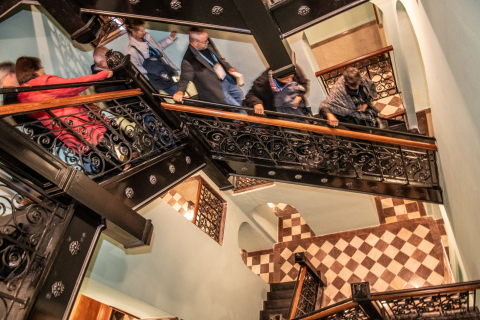
“We were lucky he came up with those,” Clark said. “That wasn’t the kind of record anyone was required to retain. I’m surprised nobody had thrown them away. We had no idea what it was supposed to look like.”
The courthouse was the county’s third, built in 1895 out of granite to try to stem the tide of arsons that burned down the previous buildings. The county took out a 50-year-bond to pay $140,000 for design, construction and debt service.
“The people of Wise County were tired of having their courthouse burned down,” Clark said.
When the county remodeled what was, and is again, a two-story courthouse in 1958, architects removed a sweeping balcony to turn the upper half into a second courtroom. The restored courtroom played host to the Storytelling Symposium portion of the Board meeting.
“The district courtroom, that’s the showstopper,” Clark said. “It was exciting to see that district courtroom get demoed out to have it just reopened as a big, wide open, two-floor space.”
Examining an I-beam helped divine some more of the original plans for the courtroom, and architects were able to combine notes on the actual beam with the existing courthouse in Hopkins County designed by the same architect, James Riely Gordon, to restore the arched ceiling.
Clark eyed the restoration in his first run for county judge 12 years ago, and has been allocating money as a match for the state grant.
“As we grow, we don't want to lose our county character,” he said. “The newcomers will want to be part of our history and appreciate where this county came from.”
The county also allocated some American Rescue Plan Act funding for the project.
“It’s really an impossible undertaking for a lot of counties on their own,” Clark said. “We couldn’t have done it without the Texas Historic Courthouse Preservation Program.”
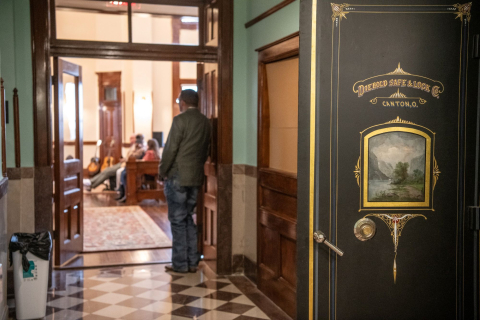
The program helped fund replica windows for the exterior and refinishing the original furnishings and wrought-iron railings. Removing layers of white paint on a vault door revealed a painting, which was also restored to its 1895 condition, one of many details that takes a visitor back 130 years.
“It’s back to being the aspirational building that our county fathers built,” Clark said. “And they did that for a reason. They wanted to set a tone for the county.”
And he and his colleagues are a lot more enthusiastic about the public and visitors stopping in to see what the courthouse has inside.
“You walk in there now and you feel it's pride and respect for this community, for the county government, and for the business happening there. If the Commissioners Court could see it today, they would know and recognize how we’ve cared for the courthouse.”
Related News

County craftsman celebrates the American flag
Blue Earth County, Minn. Commissioner Vance Stuehrenberg has refined his skills as a woodworker, designing commemorative American flag gifts for colleagues and organizations.

County invests in suburban art groups
Cook County, Ill. made grants available to suburban arts organizations to balance disinvestment outside of urban areas.

San Diego County addresses growing gaps in arts funding
San Diego County, Calif. is investing millions of dollars into arts and culture programming for diverse and underserved communities as the city of San Diego prepares to slash $11.8 million in arts and culture grants.
County News
NACo Board approves new outreach campaign, new affiliate
NACo will launch a public awareness campaign in 2026 promoting the role of county governments to federal policymakers.
