Museum expansion amplifies a rural county’s story


Key Takeaways
The Carter County Museum has all sorts of “good bones.”
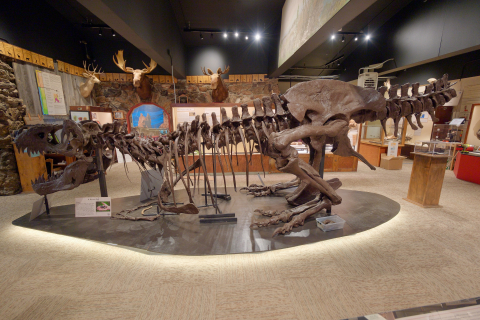
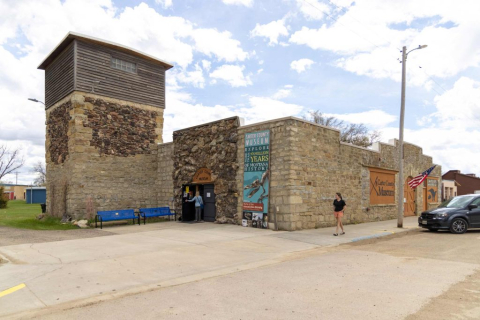
Now in its 90th year, the museum is Montana’s oldest, and its organizational structure has put it in a strong position to grow. The former auto garage in Ekalaka that houses its collections is marking 100 years in 2026 and is primed for a major addition this fall. The dinosaur fossils on display draw visitors and researchers from around the world and complement the artifacts tracing human migration and local history.
All converge to amplify Carter County’s story like a bullhorn over the badlands and prairies that eastern Montana shares with Wyoming, North Dakota and South Dakota. The museum’s leaders are pushing to be more than just a repository of the past.
“I’ve always felt that rural museums have an opportunity for a real impact in their communities, not only to be a kind of force of orientation for visitors that come through, but also a real resource for locals,” said Sabre Moore, the museum’s executive director. “Not just for history, but for community. We host sewing soirees, craft workshops, a local lecture series and a book club. We do quite a bit here as a community center, not just as a museum.”
Moore, originally from Wyoming, is here because her husband, Carter County native Nate Carroll, recruited her and several friends from Montana State University in 2013 to volunteer for the museum and launch what became the annual summer Dino Shindig. Carroll is now the museum’s curator.
Since Moore took her job 10 years ago, visitation has increased 300%, bringing in 5,500 visitors in 2025. Counting outreach to other museums, conferences and online programs, 150,000 people are likely viewing some information from the Carter County Museum.
In addition to its dinosaur fossils, the museum maintains collections of human history, including exhibits on tribal history, the Tooke Bucking Horses, local veterans, the Civilian Conservation Corps and homesteaders. Carroll is developing an exhibit showing how Carter County’s borders formed.
“We used to be part of Custer County before we were carved up into Fallon County and then carved up into Carter,” he said. “As a paleontologist and geologist, that line between Carter and Fallon now curiously follows oil reserves. How we draw lines and how we define county is in a lot of ways the history of resource allocation.”
He’s seen how the long-extinct species that were native to Carter County have shaped its future beyond its boney collection, and how geology has driven land use.
“A lot of things about whether you raise sheep or harvest barley on your ranch is in some ways kind of dictated by whether or not there’s a sea reptile or a primitive primate beneath you,” he said. “When you’re working in a museum that is placed-based, you just have all these really fun crossovers. We’re going to have a map of where all these digs happened and whose ranch they took place on.”
Big things coming
Soon after dinosaur fossils were discovered in the West, they were exported to museums in cities like Chicago and New York. After watching so many natural resources leave town, two Carter County legislators passed a bill allowing Montana counties to fund museums, in hopes of stemming that flow. The counties own and insure the buildings and property and employ the staff, while nonprofits like the Carter County Geological Society own the collections, the gift shops and all outreach activities and events. Moore reports to both the geological society’s board of directors and the county commissioners each month and manages two budgets.
The museum’s looming expansion is funded by a combination of private fundraising, private fundraising and $1 million in Payments in Lieu of Taxes funding that the Board of Commissioners allocated. In early April, the state announced a $1.25 million grant to the museum that could grow to $2.7 million.
Commissioner Pamela Castleberry said the county’s support of the museum’s growth reflected its position in the county’s identity.
“We have people in this community who kept triceratops skulls in their living rooms because there wasn’t anywhere to put things,” she said. “The story of Carter County comes out again every year when a different family’s ranch is celebrating 100 years — there’s so much history here. Every time I go there, I marvel at something new, someone’s contributions, whether they found fossils or worked in the museum when it was in the high school basement, or helped build the current museum.”
The expansion will add 15,000 square feet to the current 5,000 square foot building and, crucially, add bathrooms, which will make the museum more enticing to school groups. It will include a planetarium and multi-use community space, paleontology lab and more exhibit space. The current museum can display roughly 12% of its collection, but Carroll hopes that will increase to nearly 80%.
This is all big news for Carter County, which is among the more remote communities in a large state. Most trips to Ekalaka take at least an hour, and only recently have the major roads been paved.
Home is where the history is
Carroll grew up helping with paleontological digs in the area, building friendships with graduate students who traveled from the Los Angeles Museum. Upon returning home, he learned that any formal dinosaur scholarship would require lateral research and archival skills.
“To get to the dinosaurs, you have to get permission from folks who own that land,” he said. “I didn’t realize how much that was going to be part of my job or how much I would enjoy it, even going through land records or going through our photo archives.”
Carroll notes that much of the land where fossils were unearthed remain in the same families’ hands generations later.
“There are a lot of fun things about being in a community that has grown up with the museum,” he said. “There are still quite a few folks around here who aren’t that far removed from being involved with the digs.”
He also feels his background helps make him a better educator.
“Growing up in a community, you kind of get an idea of what connections are the most effective teaching tool, like the best analogy to get this concept across,” he said.
And his work keeps him connected to residents who demonstrate that there is a living, growing community surrounding these long-dead objects.
“I often have family members who come in and want to see a fossil that Grandpa Bill found, or to see Grandma Gladys’ shell collection,” he said. “It’s kind of rare to have a true community-built museum.”
Although Ekalaka and Carter County are remote, Moore and Carroll are making sure the museum is connected. The museum is one of 15 on the Montana Dinosaur Trail, and the July opening of the Theodore Roosevelt Presidential Library in North Dakota brings the potential of new visitors. Ekalaka is relatively close, on a Western scale, to Devils Tower in Wyoming and the Rapid City and Deadwood areas of South Dakota and the Black Hills, with the Mount Rushmore and Crazy Horse memorials nearby.
In addition to returning to the museum that fueled his youth, Carroll and Moore have seized an opportunity to do more in their careers than they could have imagined in metropolitan areas. Carroll can sleep in his own bed and still work in the field where fossils are uncovered every day, rather than leave his family for weeks at a time to do that work elsewhere. Moore has been able to work at a high level in her field at a much earlier point in her career than her peers. Together, they get to make substantial contributions to the county’s history and build an amenity for a county that recorded its first population increase between 2010-2020 after eight decades of decline.
“I get to be involved with building a museum, which is a pretty rare experience for any young curator,” Carroll said. “The fact that we’re able to do these things is a credit to the county officials who set this in motion 90 years ago.”
Related News


Seniors in Loudoun County, Va. build community, reflect with memoir group
The Loudoun County, Va. library system's memoir group provides seniors with an outlet to reflect on their lives through memoir writing and share it with a cohort of their peers.

County craftsman celebrates the American flag
Blue Earth County, Minn. Commissioner Vance Stuehrenberg has refined his skills as a woodworker, designing commemorative American flag gifts for colleagues and organizations.
County News
Former Bowling Alley, Ice Rink Resurrected as New County Museum
