Midterm election results set up divided government and a lame duck agenda for counties
Author

Ben Gilsdorf

Kevin Moore
Upcoming Events
Related News

Key Takeaways
Note: NACo follows the Associated Press’s (AP) decisions on which races have been decided
Counties administer federal elections. In 2024, counties coordinated nearly 730,000 poll workers across more than 85,000 polling places, and county jurisdictions processed more than 88 million voter registration transactions between the 2022 and 2024 general elections. The results of these elections in turn shape the federal policies that affect every county.
With Democrats set to control both chambers in the 120th Congress, counties should expect congressional priorities to shift, and NACo will keep working with members of all parties to advance counties’ interests and priorities.
Where Congress stands
During Tuesday night’s midterm elections, Democrats took control of both the U.S. House of Representatives and U.S. Senate. Although multiple races in both chambers have yet to be called, Democrats won enough seats for major outlets to confirm their win. This will mean that the next two years in Washington will see divided power, with Democrats in charge on Capitol Hill while President Trump remains in the White House.
U.S. House of Representatives
Going into Election Day, Republicans held a narrow majority of 218 to 214, with one independent and two vacancies. On Tuesday night, Democrats flipped control of the chamber, with the final margin yet to be determined.
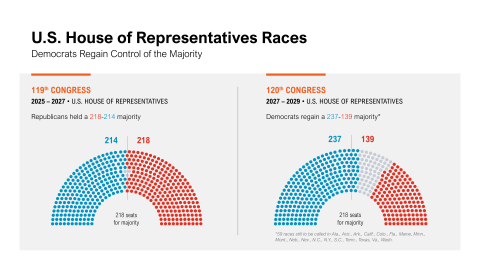
In the House, Democrats won Republican-held seats that former Vice President Kamala Harris had won in 2024, flipped several seats that President Trump had narrowly won and even won seats that had voted for President Trump by larger margins. Democrats also won multiple seats in North Carolina, Texas and Florida that had been redrawn in ways expected to favor Republicans.
U.S. Senate
Entering Tuesday, Republicans held a majority in the Senate with 53 seats. Democrats held 45 seats, with two independents caucusing with them as well. Democrats regained the chamber, flipping at least 7 seats with two outstanding in Mississippi and Alaska at the time of writing.
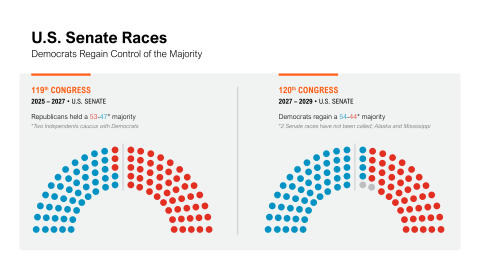
Democrats retained open seats in New Hampshire, Michigan and Minnesota while flipping seats in North Carolina, South Carolina, Ohio, Kansas, Maine and Texas. Republicans held closely contested seats in Florida and Nebraska.
Governors and state legislatures
Democrats also made gains in state capitols and state legislatures. They won open, highly contested governors’ races in Ohio, Kansas and Iowa and defeated incumbent Republicans in Nevada and Texas. Republicans, meanwhile, won contested open governors’ seats in Florida and Tennessee.
As votes continue to be counted, Democrats are also expected to gain control of multiple state legislatures. The party gained trifectas in Wisconsin, Minnesota and Pennsylvania, while flipping the state house of representatives in North Carolina and Georgia. Majorities in several state legislature chambers have not yet been called, including the Texas House of Representatives and the Arizona Senate.
Ballot measures
Multiple ballot initiatives across the country sought to make changes to county revenue authority, governance structure and the requirements imposed on counties when fulfilling duties like elections administration.
Florida voters passed Amendment 3, a ballot initiative to expand the homestead exemption for non-school property taxes. This is expected to have significant impacts on Florida counties’ abilities to collect revenue and fund vital services. Voters in Wyoming rejected a similar proposal. Louisiana, Tennessee and North Carolina voters also considered measures that would impact property taxes.
Several states, including Arizona, Alaska, Arkansas and Kansas voted on ballot measures affecting elections administration, including voter identification requirements and language limiting voting to only American citizens.
In Arizona, voters passed Proposition 319, which will prohibit state and local authorities, including counties, from using photo enforcement systems to enforce certain traffic laws.
County connections
In addition to running federal elections, current and former county leaders were also on the ballot for federal and statewide positions across the country. With some races still being called, former county leaders have won major seats thus far including Wisconsin Governor-elect David Crowley (Milwaukee County Executive), New Hampshire Senator-elect Chris Pappas (former Hillsborough County Treasurer) and California Congresswoman-elect Hilda Solis (Los Angeles County Supervisor).
Lame duck
The 120th Congress will begin in January, leaving two months remaining for legislators to pursue priorities before leadership changes. Congress is currently facing a December 11 deadline, when the current Fiscal Year 2027 Continuing Resolution (“CR”; P.L. 119-113) is set to expire.
This CR extended government funding, as well as authorizations for surface transportation programs and other federal programs. Additionally, the CR provided for an implementation delay of the proposed Uniform Guidance rule from the Office of Management and Budget (OMB).
Before the end of this CR and the 119th Congress, in the period known as the “lame duck,” NACo will continue to engage with Congress on several priorities, including:
- Government Funding: NACo urges Congress to pass either a full FY 2027 appropriations bill or another CR to prevent a government shutdown and keep key programs funded in the new year.
- OMB Rule Delay: The proposed OMB Uniform Guidance rule would have significant impacts on counties’ ability to deliver key services using federal funding. Counties, along with other intergovernmental partners, are urging Congress to further delay the rule’s implementation.
- Surface Transportation: The Infrastructure Investment and Jobs Act (IIJA) expired on September 30, 2026. While Congress extended its authorities, many of the programs that had been funded through the law’s “Division J” have lost funding. NACo is pushing for Congress to either pass a multi-year surface transportation reauthorization bill or extend IIJA’s authorities and its programs funded through advance appropriations.
- Permitting: The Bipartisan American Affordability and Jobs Act (BAAJA) would overhaul America’s permitting laws to accelerate infrastructure project timelines while preserving opportunities for local input. NACo is calling on Congress to pass the BAAJA before the end of the year.
- Secure Rural Schools: The Secure Rural Schools program provides critical funding to counties with a significant amount of National Forest System. This program expired on September 30, 2026, creating fiscal uncertainty for forest counties. NACo is asking Congress to pass the Secure Rural Schools Reauthorization Act of 2026 (S. 5608), which would reauthorize the program through FY 2029.
Resource
2030 Decennial Census Proposed Rule: County Advocacy Hub

Related News

Counties Mark Six Years of Operation Green Light for Veterans
County buildings and landmarks light up in green November 4-11, showing support, highlighting resources available for veterans and their families.


NACo submits comments on Census Bureau's proposed rule on the 2030 decennial census
On September 10, the U.S Census Bureau published a proposed rule to the 2030 Decennial Census that would create two new parts of the 15 Code of Federal Regulations (CFR) that among other changes would a) define “usual residence” that excludes foreign persons previously counted that are not U.S. citizens or lawful residents, and b) would eliminate any questions about race, ethnicity and sexual orientation from the census questionnaire used to enumerate the population. The proposed ruling outlines only 30 days for public comments, which are due on November 2.