WIR meeting focuses on disaster recovery following Maui wildfire


Key Takeaways
WIR isn’t just PILT and SRS, and that’s A-OK. This year, programming for the Western Interstate Region (WIR) Conference focused on an existential threat faced by western counties — disasters.
Against the backdrop of the Lahaina wildfires, WIR drew its largest ever attendance to Maui County, Hawai’i May 5-8 — nearly 700 registrants. Officials from different parts of Maui County’s government shared their perspective on the August 2023 wildfires, offering practical insights that county leaders could take home to refine their disaster mitigation, response and recovery operations. That brought visitors to a region fueled by tourism.
“I am absolutely convinced that our commitment to a community-led recovery, and our relentless pursuit to move from response to readiness has helped guide us through one of the most difficult chapters Maui County has ever faced,” said Maui County Mayor Richard Bissen, Jr. “It is our hope that by sharing our experiences, challenges and lessons learned, we may help others by offering guidance, support and perhaps even a small measure of hope to other communities facing similar hardships.”
WIR assembles counties from the 17 westernmost states, usually to discuss issues central to communities with significant portions of publicly owned land, including federal funding, disaster response, natural resources, tourism and land stewardship.
Maui County last played host to NACo’s Annual Conference in 2005, and the WIR Conference came to Kauai County 10 years later.
The region’s membership elected Fremont County, Colo. Commissioner Dwayne McFall as its new president, with Klamath County, Ore. Commissioner Derrick DeGroot serving as first vice president and Modoc County, Calif. Supervisor Ned Coe running unopposed for second vice president. Immediate Past President John Peters, a Mono County, Calif. supervisor, closed out 17 months as WIR president, including filling the remainder of Wes McCart’s term after he left the Stevens County, Wash. Board of Commissioners.
The 2027 WIR Conference will be held in Douglas County, Nev.
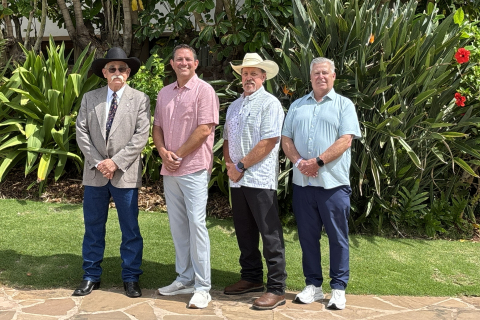
Immediate fire response
The fire started from some early electrical sparks that received prompt attention from emergency responders and was fully contained. Hours later, strong winds reignited it.
“The fire trucks weren’t gone for more than 45 minutes,” said Maui County Councilmember Tamara Paltin, who represents the Lahaina area and lives nearby.
In 17 minutes, nearly 1,700 homes burned and 102 residents died. Winds reaching nearly 100 miles per hour spread the flames, which fed mainly on invasive vegetation that was dried out. People dove into the ocean to avoid the flames. Falling trees blocked exit roads, and nearly half of the residents of a senior living home were unable to escape.
“We could have had every single fire truck and apparatus in all of California and we still wouldn’t have stopped it,” said Maui County Office of Recovery Administrator John Smith. “It was the wind. And we just have to recognize that as a reality,” when second guessing the response to the fire.
Local leaders balanced the efforts in helping the community grasp the human toll with Lahaina’s recovery. The county removed more than 400,000 tons of debris and tried to shelter as many survivors as possible.
“In the immediate aftermath of the fire, there was really no thought to policy,” Paltin said. “It was just setting up a hub and distributing food and trying to make sure everyone’s immediate needs were met. I think I didn’t even leave West Maui for at least the first month and a half or so.”
The housing displacement multiplied problems. Residents were housed in local hotels before the Federal Emergency Management Agency brought in temporary shelters, but the contracted housing availability also affected tourism —the region’s main economic driver — and the workforce coming in from other Hawaiian islands or the continental United States to rebuild homes. And it wasn’t sustainable for local families.
“Although we’re so grateful to the hotels, for housing them, when you’re having to leave every couple weeks from one hotel room to another, from one hotel to another, from one Airbnb to another, you’re not recovering, you’re still just surviving,” Paltin said. “And the longer that goes on, the harder it is for families to function, to be able to fill out even one more application to get the help that you so desperately need.”
FEMA brought in 169 temporary homes — the county code prohibits trailers — that will be transferred to the county in 2027.
Maui County held 130 community meetings to help determine how best to conduct recovery operations with an eye toward community restoration.
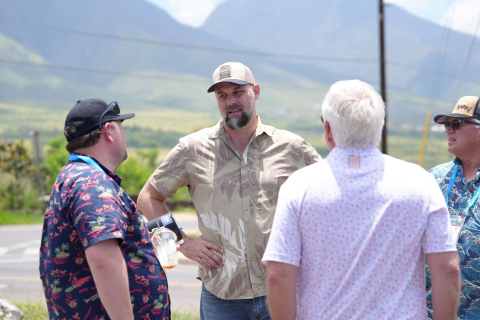
Intergovernmental traffic control
Early on, new county legislation tied off-street parking requirements to the number of bedrooms in a house, rather than square footage, aiming to reduce the amount of on-street parking that narrowed access for emergency vehicles.
Paltin is a member of NACo’s Intergovernmental Disaster Reform Task Force, which is recommending FEMA’s adoption of a universal application for disaster assistance.
“We had a lot of people suffering from application fatigue,” she said. “The standard practice is to deny you the first time and it’s just disheartening by the 12th application that you filled out 50 pages with information that you no longer have and how to get from all the sources.”
A year after the fire, the county established an Office of Recovery, which directs work in Lahaina, rather than adapting existing county departments.
“We realized that to rebuild the entire town and do it efficiently and to do it in a coordinated way, we needed an organization that sits at the top of the org chart in the county that could direct traffic for all of our departments,” said Smith, who was a county highway engineer. “We had to do something different. Public Works still has a huge role, but they can’t also interact with FEMA and the state.”
The county has exempted fire-affected residents from property taxes for four years.
Homes on the hillside have been the fastest to return, but the historic district, which once served as capital of the Kingdom of Hawaii and the commercial sector. have been slower. The county is eying a 2030-2031 restoration of residential housing.
The county also loaned a developer $3 million to fund the replacement for a one-year-old multifamily complex that was destroyed.
“You’ve got to do crazy stuff like that to make it come back,” Smith said. “Otherwise, there’s no building there.”
Maui County eventually contracted out building permit work to a third party, based on a suggestion by NACo Immediate Past President James Gore, who has experienced wildfires in Sonoma County, Calif., where he is a county supervisor.
“The idea of doing it that way and not burdening your staff with doing 10 times the amount of work they would normally have to do in one year is well worth it,” Smith said.
Bissen said that an expedited permitting process has reduced approvals to days, and by early May 2026, 192 homes and buildings have been completed in the burn zone, with nearly 600 more permits approved or in process with another 350 under review. Approximately 310 sites are actively under construction, with 500 housing units complete. That includes 10 affordable housing projects and 1,200 apartments and homes in progress.
“While those numbers matter, what matters most, what they represent is families coming home,” Bissen said.
Habitat for Humanity Maui, which was already active in Lahaina before the fire, is accelerating its work. Previously building four homes a year, the organization is dedicating a newly built house every five weeks for the next four months.
“Before the fires, it took me 18 months to get a permit. Our current permitting time on Maui is 330 days,” said Habit for Humanity Maui Executive Director Matthew Bachman. “If you are in the burn zone, we can do it in three months. And so, we’ve been able to really push that, move that needle successfully.”
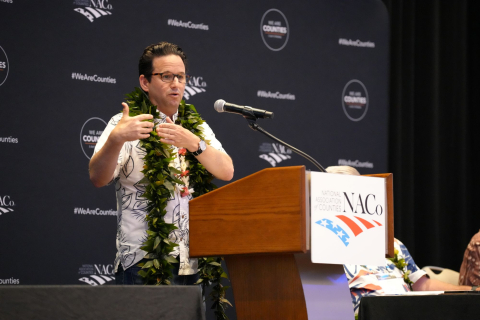
A funding fix
The county’s housing assistance program, dubbed Ho‘okumu Hou, pays up to $1.2 million to rebuild a single-family home based on household income, up to $400,000 in homeowners who have already completed reconstruction or $600,000 in assistance to first-time homebuyers.
That program is managed by the county Office of Recovery which handles $2 billion in recovery funding for Lahaina, $1.6 billion of which comes from the Community Development Block Grant Disaster Recovery Program — CDBG-DR.
That program has worked out so far for Maui County, but Sen. Brian Schatz (D-Hawai’i) said the program is in a precarious position.
“The problem with CDBG-DR is there is no originating statute. There are no established best practices, never mind a dedicated office to administrator it,” he said. “What that means for affected communities is that their own unmet needs can go unaddressed for months until Congress gets around to doing something about it,” by appropriating money for the Disaster Relief Fund.
Schatz proposes permanently authorizing the program, codifying requirements and establishing an office to run it.
“When CDBG works, it is a true lifeline,” he said.
Likewise, Schatz is a proponent of risk mitigation.
“The best thing we can do is actually work [to] take down that risk, not to be a backstop against it,” he said. “If Lloyd’s of London won’t do reinsurance, I’m sure your county government is in no position to help, but we are in a position to take down the risk.”
He is sponsoring a bipartisan bill that would equip FEMA to help state and local governments improve evacuation runs through better infrastructure planning.
“We did not understand the magnitude of the importance of having evacuation [routes] around us,” he said of Lahaina. “It’s an old plantation town with one way in and one way out and no one contemplated this type of disaster. If we had evacuation routes, it is possible that lives would have been saved.”
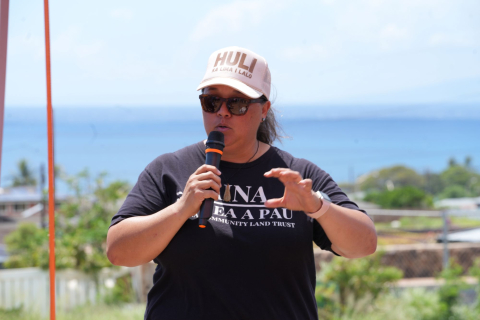
Rebuilding Lahaina
“For us, recovery is not only physical, it is cultural, it is emotional and it is spiritual,” Bissen said. “This journey has never been solely about rebuilding structures. It has been about restoring stability, rebuilding trust, preserving culture and bringing hope.”
Though houses are coming back, much of the town is a relatively blank canvas, littered with foundations and cyclone fences protecting empty swimming pools. Residents and county officials are concerned about gentrification and worry that neighbors will sell their land and start over somewhere else, giving up their investment in the community in the process.
“Nobody was thinking about what Lahaina’s going to look like,” said Autumn Ness, executive director of the Lahaina Community Land Trust. “You ask New Orleans and ask Houston and ask other big communities that rebuild after a disaster if the people that were there at the time of disaster are still there 10 years later. The answer is a lot of times ‘no.’”
The Lahaina Community Land Trust is shooting to protect 20% of homes in the next 10 years, buying land on the speculative market and selling rebuilt houses — but not the land.
“I don’t think people understand the 10-, 20-year trajectory after a disaster,” Ness said. “It’s not just about rebuilding the structures, and it’s not even … ‘I hope all of our neighbors come back.’ But when your neighbors get replaced by profit-driven investors from somewhere else, the character in the neighborhood changes, it’s less safe for your kids to ride their bikes down the street. The culture… of this place, that you guys all come here for, starts to erode, and it’s so slow, you almost don’t even notice it.”
Similarly, if a homeowner receives funding from the county’s Single-Family Homeowner Reimbursement Program, there are timeframes that give the county the right of first refusal to buy it if the owner sells. The Maui Habitat for Humanity chapter will offer loans of up to $100,000 that will be forgiven if a house remains owner-occupied for 10 years.
Throughout the process, 82 cultural monitors and observers helped protect significant and sacred ground in Lahaina, providing cultural sensitivity training to contactors from all over the country, ranging from Mennonite woodworkers to Hawaii Electric crews, FEMA workers and the Army Corps of Engineers.
“We are dealing with a lot of contractors that never ever worked in Hawai’i before,” said Kapono‘ai Molitau, executive director of Maui County Office of ¯Oiwi Resources, a department that ensures proper management of indigenous resources. “Nobody goes to work in Lahaina town unless they go to sensitivity training. It gives me an opportunity to interrogate everybody that comes to our hub.”
Recovery is intertwined with resilience out of necessity, and flooding in March after repeated storms was a chance to “test this place like it has never been tested,” Smith said of the hillside homes.
“I’m happy to report that because the county made these units install basins, we stopped [the rains] from flooding the neighborhood.”
Related News

Post-Disaster Protection Act advances through the House Transportation & Infrastructure Committee
On Sept. 15, the House Transportation & Infrastructure Committee passed the Post-Disaster Protection Act (H.R. 8409), favorably reporting it to the full legislative body for consideration.

NACo submits comments on proposed CDBG-DR formula change
NACo submitted comments to the U.S. Department of Housing and Urban Development (HUD) on its notice proposing changes to the CDBG-DR formula, the methodology HUD uses to calculate disaster recovery allocations to states and localities

County News
Maui County residents rebuild their lives after deadly 2023 fire
Speeding up the permitting process is one small way Maui County is helping residents rebuild their homes and lives after last year’s devastating wildfires.
