President signs bipartisan Infrastructure Investment and Jobs Act
Upcoming Events
Related News

Key Takeaways
NACo leaders attended the White House signing ceremony for the bipartisan infrastructure package, applauding the enactment of the bill and emphasizing NACo’s commitment to working with federal partners on its effective implementation.
County leaders in attendance included NACo President Larry Johnson and NACo Transportation Committee Chairwoman Liz Hausmann.
“Counties across the country are ready to move forward on long-overdue infrastructure projects that will help our residents and communities thrive,” said Johnson, a DeKalb County, Ga. commissioner. “This bill is where the rubber meets the road. We appreciate our House and Senate partners and members of the administration who worked with us to develop this comprehensive legislation.”
Hausmann is a Fulton County, Ga. commissioner.
“The bipartisan infrastructure package invests in locally owned infrastructure,” she said. “These investments will help make our communities safer and our economy stronger. We look forward to continuing to work with our federal partners on implementation.”
The IIJA provides $973 billion over five years from Fiscal Year (FY) 2022 through FY 2026, including $550 billion in new investments for transportation, water, power and energy, environmental remediation, public lands, broadband and resilience. Of the $550 billion, $284 billion will go toward all modes of transportation, with the remaining $266 billion invested in other physical infrastructure sectors.
The bipartisan infrastructure package will accomplish many longstanding county priorities, including:
- A new, long-term surface transportation reauthorization for highways, roads and bridges, public transit and rail systems
- Meaningful commitments to transportation safety and project streamlining
- Critical new investments in water, stormwater and broadband projects
- Increased investments in county owned bridges that are not part of the federal-aid highway system
- Raising the cap on Private Activity Bonds, which will facilitate the construction of infrastructure projects, and
- An extension of the Secure Rural Schools program for timber harvest counties for three years.

“We are pleased that our federal partners have recognized the critical role counties play in our nation’s infrastructure,” said Executive Director Matt Chase. “As America’s counties fulfill our vast infrastructure responsibilities, we appreciate a strong federal-state-local partnership to make much-needed investments in building and strengthening infrastructure for the future.”
Counties play a major role in maintaining critical infrastructure. Counties:
- Own 44 percent of the nation’s road miles and nearly 40 percent of all bridges
- Are involved in the vast majority of public transportation systems and a third of all public airports
- Are responsible for the operation of local water systems, and
- Invest in the safety and resiliency of our communities.
Read NACo’s executive summary of the infrastructure bill here. See the latest federal transportation and infrastructure policy proposals impacting counties here. Learn more about NACo’s transportation and infrastructure priorities here.
The bill passed the House of Representatives 228-206 earlier this month and the Senate in August on a 69-30 vote. The IIJA provides $973 billion over five years from Fiscal Year (FY) 2022 through FY 2026, including $550 billion in new investments for transportation, water, power and energy, environmental remediation, public lands, broadband and resilience.
These transportation funds represent roughly 52 percent of all new resources provided for in the bill to modernize and improve transportation infrastructure, with the majority of funding reserved for highways, roads and bridges. Investments include:
- Roads & Bridges: $110 billion
- Transit: $39 billion
- Rail: $66 billion
- Safety: $11 billion
- Airports: $25 billion
- Ports & Waterways: $17 billion
- Electric Vehicle Charging: $7.5 billion
- Electric Buses: $7.5 billion
- Reconnecting Communities: $1 billion
Counties can access IIJA transportation funds in three general ways: 1. Meeting certain eligibility criteria for formula funds; 2. Receiving suballocations from state governments; and/or 3. Applying to the U.S. Department of Transportation (USDOT) or a state department of transportation for competitive grant opportunities. The IIJA also provides just over $100 billion in direct, competitive grant opportunities through USDOT to local governments over the life of the bill.
In addition to transportation, the legislation also provides the following:
- Water: $55 billion
- Broadband: $65 billion
- Energy & Power: $73 billion
- Environmental Remediation: $21 billion
- Western Water Infrastructure: $8.3 billion
- Resiliency: $46 billion
The IIJA is a major victory for counties, who worked closely with our partners in Congress throughout the legislative process to ensure county priorities were included. Owning and operating 44 percent of public roads and 38 percent of the nation’s bridges while directly supporting 78 percent of public transit systems and 34 percent of airports, counties are play a significant role in the nation’s infrastructure network. Annually, counties invest $134 billion in the construction of infrastructure and the maintenance and operation of public works. Though we are doing our part at the local level, we must rely on the intergovernmental partnership to meet our many public infrastructure responsibilities, as well as to reach our federal, state and local shared goal of improving the nation’s infrastructure.
The next step for the IIJA is implementation. NACo is working closely with the U.S. Department of Transportation and other federal agencies impacted in the legislation to ensure America’s counties have the information and guidance necessary to successfully execute the policies and programs in the IIJA. At the local level, we know that bipartisan solutions provide long-term benefits, and counties applaud Congress and the White House for working across the aisle to enact this historic investment in America’s infrastructure into law.
Attachments
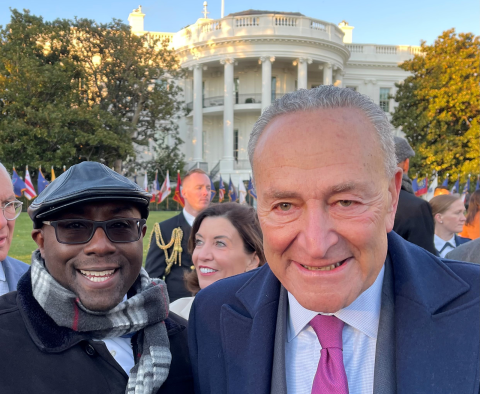
NACo President Larry Johnson (left) attends the Nov. 15 bill signing with Senate Majority Leader Charles Schumer (D-N.Y.). New York Gov. Kathy Hochul (D) stands behind them.
Related News

Federal funding extension creates transportation funding cliff for counties
On August 8, the Senate Appropriations Committee passed a proposal to extend government funding and many expiring program authorities until December 11, 2026. Notably, this bill would provide a short-term extension of many federal surface transportation programs authorized in the Infrastructure Investment and Jobs Act (IIJA) (P.L. 117-58). However, the bill would not extend the advance appropriations for many transportation programs made in Division J of the IIJA. This means that many programs would lose portions of their funding, while many other programs would have their funding lapse altogether.

Counties eligible for $787 million in DOT PROTECT grants to build disaster-resilient surface transportation
Counties are eligible for federal PROTECT grants that fund projects engaged in building surface transportation systems that are resilient to weather events natural disasters.

NACo sends letter to Congressional leadership asking them to reauthorize or extend key programs
NACo sends letter to Congressional leadership asking them to prioritize reauthorizing or extending key programs for counties ahead of September deadline